
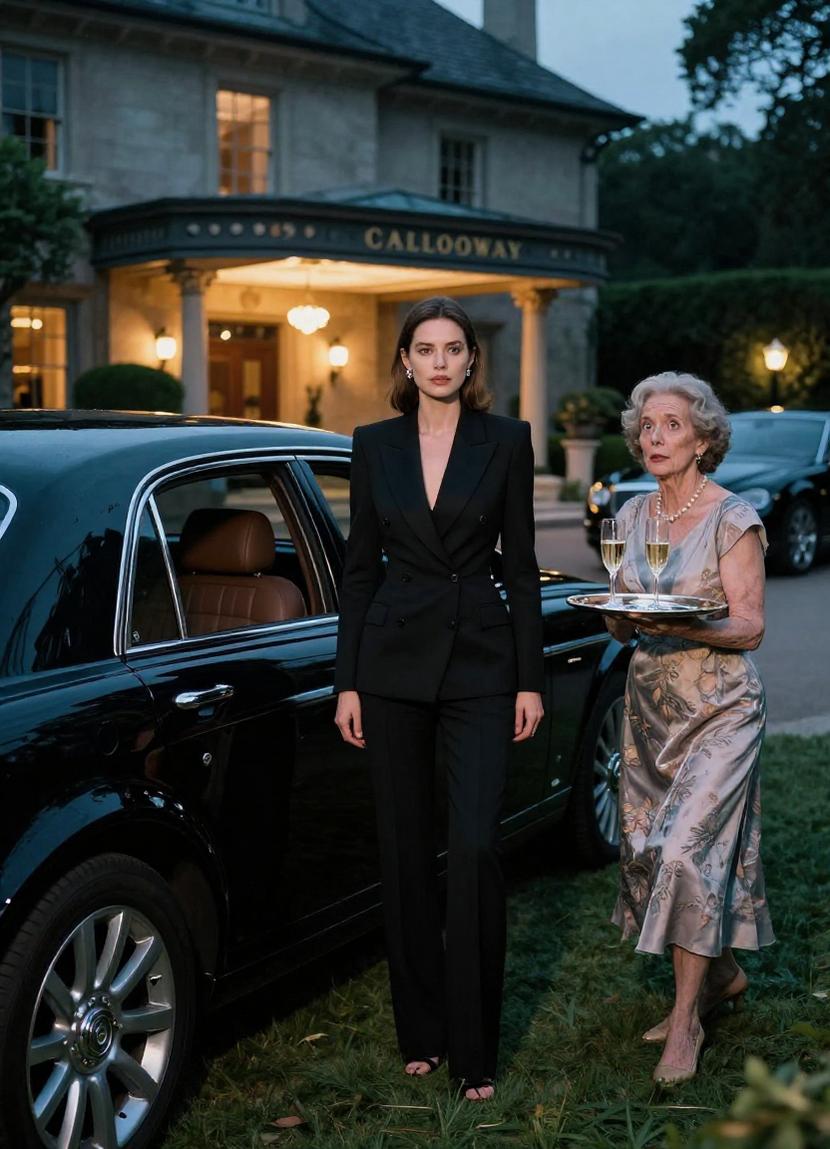
The thunderous slam of the heavy mahogany door shattered more than just silence—it was a punch, a seismic blast that rattled beneath my feet and reverberated through the cavernous entrance hall of Calloway Manor. It echoed like a judge’s hammer crushing hope, sealing my fate without a hearing.
My worn leather suitcase, hastily packed in ten jittery minutes of silent fury, tumbled down the front limestone steps. It spilled a sleeve of silk blouse onto the gravel driveway, a fragile white flag fluttering in surrender beneath the cold, unyielding stone.
‘You’re an embarrassment to this firm, Isabel!’ Richard’s furious voice roared from the top of the grand staircase. He stood like a monument himself, flanked by the Corinthian pillars he revered more than his family. His face boiled crimson with a rigid, aristocratic rage. ‘A dropout. A quitter. Don’t delude yourself into thinking you can slither back when the world chews you up and spits you out. You’re done here. Not a penny will come your way. Do you understand?’
I looked up at him, the late afternoon sun casting long, distorted shadows across the façade that had imprisoned me for twenty-four years. I didn’t scream. I didn’t weep. I didn’t plead for mercy I knew would never be granted.
My hand slipped deep into the pocket of my coat. Fingers brushed against the cold, sleek glass of my phone. Concealed from Richard’s withering eyes was the biometric interface of my crypto wallet. A subtle buzz in my palm confirmed the balance.
Sixty-five million dollars.
Liquid. Tax-paid. Diversified. Mine.
He thought he condemned me to destitution. That he stripped away my lifeline. But he was shouting at a centimillionaire who had quietly built a digital empire in the dark, sleepless hours he assumed I was flunking torts.
‘Goodbye, Richard,’ I said.
Not Dad. Not Father. Richard.
I descended the stairs, my heels clicking a calm, measured rhythm of determined departure against the cold stone. Grabbing my bag, I zipped it with methodical intent and slipped into the backseat of the black SUV waiting at the wrought-iron gate. As the tires crunched over gravel and spit dust behind us, I didn’t turn back to the ivy-clad brick walls; I gazed ahead, eyes locked on the flight plan locked for Bridgemont.
Exile ended. Empire awakening.
As the manor faded behind us, my phone chimed. Not a bank alert. A security trigger from the private server hidden deep in Calloway Manor’s basement—a vault Richard never knew existed. The ‘Dead Man’s Switch’ activated silently as I crossed the property’s geofence, setting in motion a ghost archive of every email, transaction, and shadowy secret the firm thought buried. I caught my reflection in the tinted window and smiled. They thought I was gone. But I left a specter behind.
—
The flight to California was a balm of release, a welcome contrast to the suffocating, judgment-laden silences of Calloway Manor’s dinner table, where silverware clicks pierced like gunshots and breaths were weapons. Here, in the plush, pressurized cabin of a Gulfstream G650 cruising high above, the silence was a clean sheet to start anew.
I sipped sparkling water and watched the vast American landscape scroll away beneath me, dissecting the last six years of my life like a coroner dissecting a body I was determined to resurrect.
Richard Calloway—my father—was a Senior Partner at one of Durham’s oldest, most fossilized law firms. An iron-willed traditionalist who worshipped at the altars of ‘‘The Firm,’’ antiquity, and men. His world was antiquated and cruel: women were accessories, emotional instruments to host charity galas and smother social tensions—much like my mother, Marissa. Sons were heirs, kings in waiting, while daughters were liabilities, parcels to be bartered in marital alliances that expanded portfolios.
My brother Julian, two years my senior, was anointed the Golden Child from infancy. He was propped on a pedestal bolstered by private tutors, prestigious internships, and applause for mediocrity. I, on the other hand, existed as a ghost in the halls, a shadow in the library. My early passion for corporate law earned me nothing but derision. ‘It’s a brutal world, Isabel,’ Richard once sneered, his voice dry and dismissive. ‘You don’t have the temperament for the kill.’
So, I stopped asking. I stopped speaking. I vanished.
I attended law school—essentially a holding pen in their eyes, a breeding ground for a suitable husband. But I didn’t drown in case law. Instead, I studied the real estate market’s archaic, gut-driven inefficiencies—valuations based on handshakes over golf courses and nepotistic networks wrapped in cigar smoke.
In my dorm, while classmates pored over property rights, I coded. I built EstateEye: an AI-powered valuation engine using satellite imagery, zoning data, and predictive algorithms to appraise commercial real estate with forensic precision. It didn’t guess; it knew.
By sophomore year, hedge funds licensed my software. By junior year, I’d sold a minority stake for eight figures—cloaked behind layers of shell companies and anonymity.
Now the SUV pulled me through the gates of my new reality—Silverstrand Beach, billionaire’s sanctuary.
The transition was electric. Durham was heavy velvet drapes and dark wood—old paper scents and repression. Silverstrand was glass, steel, and the brilliant cruelty of Pacific sunfeathers.
The gate slid open silently. My $42 million fortress dissolved into the blinding white and floating planes of glass. I stepped through the pivot door, and the living room seemed to hover above the restless ocean below. My suitcase echoed a hollow clang against polished concrete—I was alone.
I pressed my palm against the cool glass, the ocean’s eternal roar a steady metronome.
I had won. Escaped my father’s orbit, and built my own kingdom.
The minimal Italian furniture whispered an obscene luxury—the kitchen, a chef’s playground, destined to remain untouched by domestic hands.
Then the silence enveloped me—not peaceful, but suffocating. Money doesn’t buy happiness, I thought. It doesn’t seal the hole in your chest; it merely fashions it in marble.
I wandered through empty bedrooms, lavish sleek bathrooms, screening rooms, and wine cellars—palatial spaces meant for conviviality, yet cavernous for one. Sitting on the edge of a stately white sofa, I faced the ocean where waves crashed relentlessly.
Richard had cast me out—not for failure, but for failing on their terms. Here in my fortress of success, I felt an icy loneliness.
Buying a castle doesn’t close the wound of exile—it just provides prettier surroundings to bleed out.
No missed calls. No worried texts from Marissa. No smug messages from Julian. They’d severed me clean.
‘Good,’ I whispered, voice cracking. ‘Let them believe I’m dead.’
The Isabel they knew—the quiet, disappointing daughter—was dead. The woman in this glass kingdom was something new. The Architect. And her plans were only starting.
—
Half a year later, amid green juice sips and acquisition target analysis, a red alert pulsed on my EstateEye dashboard. A financial anomaly from a monitored asset: Calloway Manor, my childhood home.
The numbers were staggering—the mortgage in arrears and leveraged as collateral for a fragile, high-risk loan—risks taken by a firm on the brink of insolvency.
Leaning back in my iconic Eames chair, the ocean breeze drifted in, but the chill never reached me. The data told a tale of desperation: Richard’s bastion of law and stability was bleeding cash, a fragile mask of old money and pride.
My phone buzzed. The name Julian flashed—a ghost from a fractured past.
I let it ring. Once. Twice. Three times. He had to sweat.
Finally, I answered. ‘Julian.’
‘Isabel,’ his breath rushed, shaky and thin, no trace of his usual arrogance. ‘Thank God. I wasn’t sure this number still worked.’
‘It does. Speak.’
‘Look, things got… complicated. Gambling debts. Bad luck. I need fifty thousand. Just a short-term loan. I’ll pay back double.’
I almost chuckled. The classic Julian excuse. But my algorithms told the truth: a Ponzi scheme woven through client escrow accounts, patched with stolen funds.
‘Fifty thousand is a hefty sum for a dropout, Julian,’ I said flatly.
‘I know! But you always had savings from your little tech projects. Please, Isabel. If I don’t fix this, Dad will destroy me.’
He had no idea I was a shark circling the pond, waiting to draw blood.
‘I can help,’ I said.
Relief washed over him, wet and desperate. ‘Really? Thank you.’
‘One condition.’
‘Anything.’
‘Sign a promissory note. Securing the loan against your future inheritance—specifically your share in Calloway Manor.’
‘Why?’
‘Because I’m not the sister cleaning your mess for free anymore—this is business. Sign or find another lifeline.’
Silence stretched as he considered. He thought fifty grand was negligible against the manor’s fortunes.
‘Fine,’ he snapped, gratitude vanished. ‘Send the paperwork.’
I hung up and whispered to my broker: Execute Protocol Trojan Horse.
I didn’t just wire him the funds—I used that promissory note to trigger a larger move. Through my shell company, Nemesis Holdings, I bought the toxic mortgage note on Calloway Manor. The bank was eager to sell, scared of missed payments and firm instability.
I bought the debt. The deed. I didn’t just bail out Julian—I ensnared the roof under their heads.
The salt air filled my lungs as I stood on my Silverstrand balcony, the battered family now tenants in their former domain.
Two days later, an email arrived—forwarded by an oblivious former classmate: an invitation to The Calloway Firm Jubilee, celebrating thirty years of legal excellence, held at the manor this coming Saturday.
The audacity was breathtaking. A crumbling legacy celebrated under a roof they didn’t own. I stared at the RSVP button and clicked ‘Yes.’
—
This time, no train. A private jet to Bridgemont, then helicopter to a landing pad near the estate. A sleek black town car ferried me to the gates.
Calloway Manor loomed—unchanged, immortal, a shrine to exclusionary power.
Bentleys and Mercedes sparkled beneath choreographed garden lights. I stepped out, cloaked in a tailored black Alexander McQueen suit—sharp, severe, armor for the night.
Keys surrendered, I ascended the steps where my baggage once betrayed me.
Inside, the gathering swirled with Durham’s legal elite—judges, politicians, partners. The scent of expensive cologne mingled with stale ambition and centuries of privilege. Unaware their foundations teetered beneath their polished shoes.
Marissa spotted me first. Frail, her brittle smile a mask for decades of patching cracks.
She froze, clutching a trembling tray. ‘Isabel?’ Her voice a whisper, eyes flickering like I was a blot marring the tapestry. ‘Why are you here?’
‘I heard there was a celebration,’ I replied smoothly, plucking a champagne flute from a passing waiter. ‘Wouldn’t want to miss honoring… excellence.’
‘Your father… he won’t be pleased. He still thinks you’re struggling,’ she murmured.
‘Let him think what he wants,’ I said, weaving through the crowd like a shark circling prey.
The ballroom radiated heat and whispered judgments. At the front stood Richard, flushed and arrogant, glass of scotch in hand—the king of his crumbling domain. Julian, sweaty and uneasy, forced a smile beneath ill-fitting cloth.
Richard rapped a spoon against his glass, silence slicing through the murmurs.
‘Friends, colleagues,’ his voice boomed, slurring with a hint of arrogance. ‘Tonight, we honor legacy—the foundations we build to outlast ourselves.’ He patted Julian’s shoulder—a grip more chain than comfort. ‘I gaze upon my son and see the future. The law is a stern mistress—demanding strength, fortitude, men of character.’
A ripple of polite applause. The word cut sharp. Men. Not accidental; a thesis etched in years of prejudice.
‘My son has the backbone,’ Richard continued, pride unwarranted dripping like poison. ‘Unlike those who crumble—those lacking grit for the real world, chasing fantasy games.’
All eyes locked on me. No name spoken, but the room knew. They saw the failure, the dropout.
‘To Julian,’ Richard toasted, glass raised.
‘To Julian,’ they echoed.
Julian caught my gaze—no shame, smirk playing. He glanced at his wrist watch, flaunting a vintage Rolex Daytona—the very watch I’d funded. I’d wired him money, and he wore it while Richard scorned my achievements.
The cruelty was blade-sharp, effortless. I vanished through the crowd, warmth fading as applause waned.
I slinked through familiar halls, ascending back stairs to Julian’s old room—now his office.
Unlocked, arrogantly so. Inside, his laptop hummed invitingly.
Passwords mocked his laziness; birthdays failed, ‘Password123’ failed, but the name of his team unlocked the vault.
Plugging in a USB loaded with my forensic accounting tools, I dove into the rubble of financial deceit.
Julian wasn’t just borrowing to cover losses—he was orchestrating a Ponzi within the firm, bleeding new clients to pay old debts.
An email thread caught my eye: Julian and Richard, three months prior.
Subject: The Audit.
Richard wrote, ‘I fixed the Jones file accounts. This can’t happen again. The Bar must never know. I leveraged the house to cover the shortfall. Last time, Julian.’
Staining the cold light was the brutal truth: Richard wasn’t blind. He was complicit.
He toasted a criminal son while exiling the daughter who could have saved them.
I withdrew the USB, clutching the evidence. I wasn’t just the Architect now; I was the Judge.