
Clara Sanchez’s sharp, irritated voice rang down the corridor as I lay crumpled at the foot of the stairs, a relentless pounding throb vibrating through my skull like a dark drumbeat. Shadows spun wildly before my eyes, the world tilting sickeningly beneath me. My name is Clara Sanchez, sixteen years old, and just moments prior, I’d endured another one of my sister’s cruel “pranks.” Yet this time, unlike the countless before, it threatened to unravel everything I thought was untouchable.
The intricate pattern of the foyer rug dissolved and morphed in my vision, blurring like a twisted mirage. Mom stormed in, her face taut, more annoyed than alarmed. “What happened now?” she snapped, her steely eyes flicking between me and Isabel Morales, my eighteen-year-old sister, the golden girl everyone adored.
“She just tripped,” Isabel chimed instantly, a flawless cheerleader’s grin plastered on her face. “You know, Clara is always so clumsy. Probably missed a step.”
But I hadn’t tripped. I was ascending the stairs, focused on the landing above. Behind me was Isabel, closing the distance too quickly. The shove hit hard, right between my shoulder blades — deliberate and merciless. A push, not an accident. Just like all those “little incidents” over the years: subtle shoves, staged stumbles, “playful” nudges, all executed in shadows or in full view with the family’s gaze stuck elsewhere. Until now.
This time, I couldn’t just laugh it off and get back on my feet.
“My head,” I whispered, breath ragged as I fought to sit up. The room swayed dangerously, bitterness rising in my throat. “I need… a doctor.”
Mom’s eyes narrowed, lips tightening into a disapproving line. “Stop being so dramatic, Clara. If Isabel says you fell, then you fell. Besides, your father has a critical dinner with his partners tonight. No disturbances.”
That phrase—our family’s silent creed—echoed again. Don’t upset the apple cart. Don’t cause trouble. Don’t embarrass us. Isabel was the flawless star: captain of the cheer squad, straight-A student, student government president, Dad’s pride incarnate. And I was just… Clara. The quiet one. The dreamer. The problem.
As I tried to steady myself, my legs buckled beneath me. The last sound I caught before darkness claimed me was Isabel’s impatient sigh.
THE HOSPITAL AND THE LIE
I awoke to the sterile glare of fluorescent lights in the emergency room, each buzz slicing through my headache like a knife. Mom sat nearby but didn’t hold my hand—she was glued to her phone, likely rearranging Dad’s evening plans. Dad paced in his suit, a live wire of frustration about lost business opportunities.
“She’s always doing this,” I overheard him grumble to Mom. “Always looking for attention right before something important.”
Then Dr. Reynolds entered—his face grave, a stark contrast to my parents’ dismissive airs. “I’m Dr. Reynolds,” he introduced himself, scanning my chart. “We need to run some tests. Your symptoms are definitely concerning.”
Mom snapped her head up, disbelief painted across her features. “Tests? Really? She just had a minor fall. She’s clumsy.”
Dr. Reynolds’s gaze hardened. “A minor fall that results in a serious concussion and loss of consciousness is not minor, Mrs. Sanchez. An MRI is necessary to rule out bleeding or swelling in the brain.”
Dad stepped up, adopting his corporate lawyer tone perfectly: “That’s unnecessary. We have trusted specialists who can assess her tomorrow.”
But Dr. Reynolds stood firm, unwavering. “As Clara’s attending ER physician, I am ordering these tests immediately—it’s a matter of safety.” Then, softer now, he looked at me. “Clara, can you tell me exactly what happened? Did you trip?”
The truth burned hot on my tongue. She pushed me. But then Mom’s frostbite glare shot across the room—her silent command: protect the family, keep quiet.
So I whispered the lie I’d told so many times before: “I… I tripped.”
Dr. Reynolds didn’t trust it. “Before the fall—dizziness? Nausea? Has anything like this happened before?”
Before I could answer, the curtain yanked aside. Isabel burst in, still in her cheer uniform, cheeks flushed with practiced worry. “Oh my god, Clara! I was so scared!” She seized my hand with those manicured fingers — the same ones that had shoved me. “I told Mom we needed to come immediately!”
The doctor observed her theatrics closely. “You saw her fall?”
“Yes!” Isabel beamed. “She was just walking up, lost in her own world—she slipped suddenly. I tried to catch her, but it was so fast!”
Nausea churned in me—not from the concussion but from Isabel’s well-honed manipulation, twisting reality to cast herself as savior while I became the helpless, distracted one.
“The MRI will clarify things,” Dr. Reynolds insisted, marking notes. “Someone will escort you to radiology soon.”
After the doctor left, Dad turned to me with crystalline coldness. “Clara, this is absurd. Do you realize the cost? All for a bump on the head.”
“I’m sorry,” I breathed, conditioned by years of shrinking into myself whenever I caused inconvenience.
Isabel snapped, venom replacing care. “Dad’s missing his important dinner because of your attention-seeking.”
Mom rose, smoothing her designer dress with forced calm. “When we get home, this behavior of yours needs serious correction. Our family can’t have constant disruptions.”
I closed my eyes, letting their words crash over me like icy waves. But something inside me was shifting—the pounding in my skull, the weight of repressed fury building, a spark of rebellion.
When the nurse came for the MRI, my family stayed behind, glued to their phones constructing the narrative that protected their perfect image. But inside the humming, claustrophobic MRI machine, as the metal thumps echoed like drumbeats of fate, I swore I’d never be silent again.
Unknown to me, the scans would unleash hidden truths—a decade of carefully masked cruelty—and Dr. Reynolds’s next revelation would shatter the fragile illusion of my family’s perfect facade. Sometimes, truth doesn’t whisper; it shouts through images and evidence. And my brain was ready to scream my story.
THE SCANS AND THE SECURITY FOOTAGE
The results arrived far sooner than expected. Back in the ER bay, I fought the agony pounding inside my head. Mom furiously typed away on her phone, likely about the “inconvenience” this caused. Dad murmured bitter complaints about “hospital red tape.” Isabel had disappeared to the cafeteria, probably crafting her online “worried sister” persona.
Then, Dr. Reynolds re-entered, his face grave. Behind him, a sharply dressed woman trailed: Ms. Alvarez from Child Protective Services.
An icy frost fell over the room. Mom’s phone thudded onto her lap. Dad’s pacing halted; his confident facade drained away. “CPS?” Mom whispered, nervous and defensive. “There’s been some mistake; Clara just had a minor fall.”
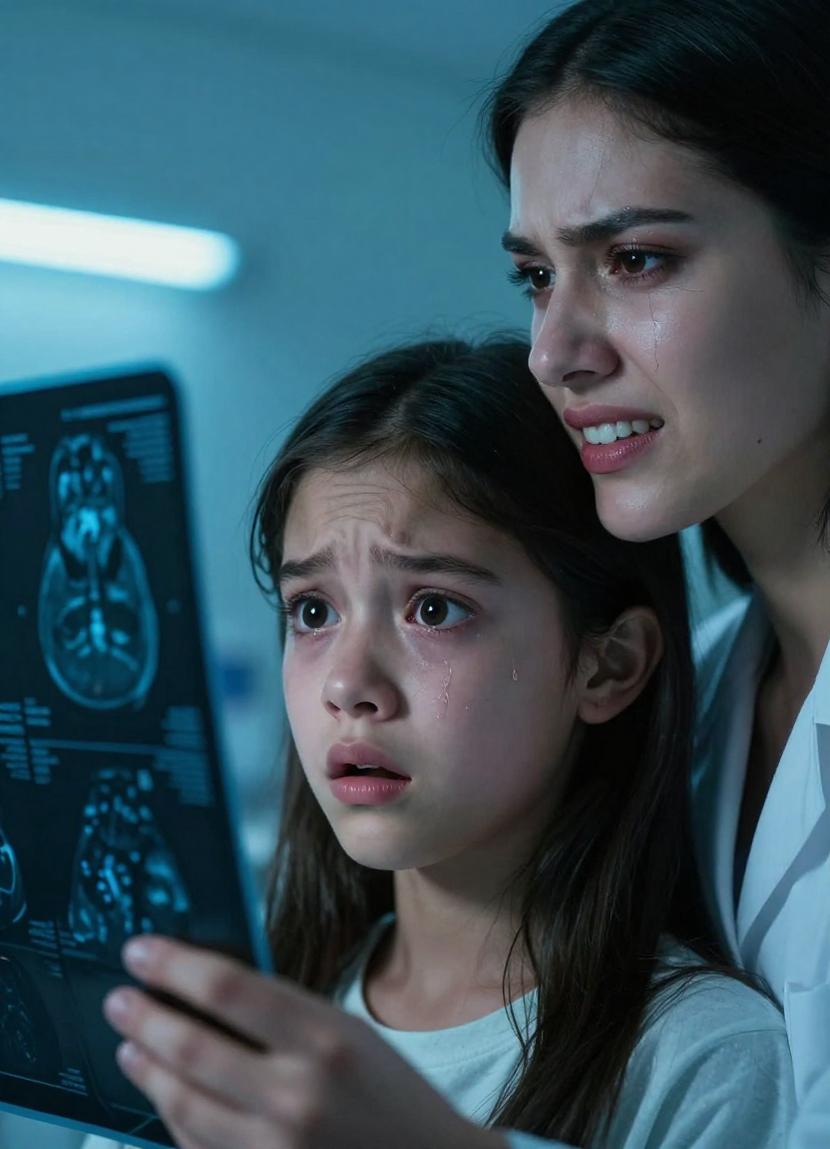
“Minor?” Dr. Reynolds’s voice was controlled yet edged with anger. He clicked the scans onto the lightboard. “These images tell a different story.”
He pointed to a glowing white spot. “This is the recent injury: concussion with subdural swelling—not ‘little.’ But more alarming are these other areas.” He traced smaller, dimmer spots scattered across the scans. “Multiple older injuries—evidence of repeated head trauma. Some recent, some older scar tissue.”
I stared, stunned. Those recurring headaches dismissed as ‘stress,’ the dizzy spells they called exaggerations—all left these scars.
“That’s nonsense,” Dad blustered, attempting damage control. “Clara’s always been clumsy, falling out of trees and whatnot—”
“These aren’t typical accidents,” Dr. Reynolds cut in sharply. “They look like targeted blows, shoves, intentional impacts.”
Ms. Alvarez stepped forward calmly but authoritatively. “Clara, would you be comfortable speaking with me privately?”
Before I could answer, Isabel stormed back, clutching a soda, wide-eyed. “What’s all this?” She took in the tense scene. Instantly her role shifted. “Oh my god, is Clara okay? I’ve been so worried!” She rushed to my side, continuing her performance. “She only tripped, like always. I tried to catch her, really!”
Ms. Alvarez wasn’t fooled. She lifted a tablet. “The hospital’s security footage tells a very different truth.”
The room fell into stunned silence. “Security footage?” Mom breathed, trembling.
The video played: grainy black-and-white footage from the stairwell camera. Me, carefully placing each step. Then Isabel, just behind, her hand lunging out—shoving me violently in the back. No accident. No stumble.
Isabel’s immaculate mask cracked, paling. “That angle isn’t right—this can’t be—”
“We have more,” Ms. Alvarez continued quietly. “Our contact at your school provided security footage too.” Another scene flickered: two months ago, by the gym—Isabel purposely barreling into me, pinning me against a brick wall. Weeks ago, in the parking lot—door slammed into my head, her laughter echoing as if it were a joke. “This isn’t an isolated incident.”
The family illusion fractured. Mom clutched her purse, hands trembling. Dad’s face drained of color, calculating legal fallout. And Isabel — my so-called perfect sister — now snarled with raw fury.
‘SHE DESERVED IT!’ Isabel exploded, voice shattering the silence. ‘Perfect grades, the quiet little artist—always making me look bad! Mom and Dad might ignore it, but I see it! She thinks she’s better than me!’
“Isabel, stop!” Mom hissed, grabbing her arm, but the floodgates had broken.
“Better grades, better art, better everything!” tears streaked down Isabel’s face, rage and pain bleeding through. “So I ‘fixed’ it—every test, every show she had coming—just a little shove, a fall, a ‘trip.’ Can’t outshine me if your head’s spinning, right Clara?”
Her confession landed like a thousand blows. All the mysterious headaches before exams. The sprained wrist before my art show. The ‘sick’ nights before recitals. Sabotage disguised as misfortune.
“Ms. Morales,” Ms. Alvarez said coldly, “you are admitting to deliberately causing harm to your sister.”
“No, she isn’t!” Dad’s voice cracked. “This is all just family drama. We’ll handle it privately.”
“Not this time,” Dr. Reynolds said firmly. “These injuries could’ve killed her. One more ‘accident’ and it could be fatal. This ends now.”
I glanced at my parents—Mom trying to minimize, Dad calculating damage control, and Isabel—the sister who had been my tormentor for years, hidden behind a mask of perfection.
“Clara,” Ms. Alvarez said gently, turning away from my parents, “would you like to tell us your side of the story?”
For the first time in years, a cold clarity surged through me. The MRI had exposed what I couldn’t explain. The footage reinforced every ignored fear. The truth was etched starkly in black and white—nothing could erase it.
“Yes,” I said, sitting straighter, voice steady despite pain. “I want to tell everything.”
Isabel lunged, nails bared, but a security guard intervened swiftly. “You little snitch!” she snarled. “After all we’ve done for you!”
“Ms. Sanchez,” Ms. Alvarez’s tone hardened, “please stop. Police are on their way.”
That word pierced through the last of my parents’ denial. Mom burst into tears—not for me, but for their image. Dad’s fingers trembled as he dialed his expensive lawyer.
But I no longer cared. The truth was free, and so was I.
UPDATE: SIX MONTHS LATER
The months that followed redrew the map of my existence. Isabel faced felony assault charges. Her spotless record (clean only because my parents had buried past incidents) and high-powered lawyers spared her from juvenile detention, but not from compulsory inpatient psychiatric care and two years strict probation. Faced with undeniable evidence and public scrutiny, my parents’ attempts to hide everything crumbled.
I moved in with Aunt Bianca—Mom’s estranged sister, who had long refused to play the family’s superficial game. Her home, nestled on the city’s outskirts, was a sanctuary filled with art, music, and unfiltered laughter. The chaos of love over cold perfection. “Your room is ready,” she said warmly when CPS approved the transfer, opening the door to a space bathed in soft blues and greens. “Here, Clara, you get to just be you.”
My neurologist confirmed what Dr. Reynolds suspected—repeated head injuries took their toll. The dizzy spells and pain would linger, but finally, I received real care instead of dismissal.
My parents fought for custody, their legal team spinning tales of “family unity” and “teenage misunderstandings.” But Aunt Bianca was unyielding. “They lost their right to make decisions the moment they ignored documented abuse,” she told the judge with quiet strength. The court agreed.
Returning to school was uncertain territory. Yet, some classmates stepped forward, revealing their own troubled encounters with Isabel. “I saw her trip you in the lunchroom last year,” one confessed nervously. “I never spoke up because… well, she’s Isabel Morales, you know?”
Mrs. Cortez, my art teacher, brought back my old sketchbooks. “I always wondered why you disappeared from Art Club,” she said gently. “Your spot’s waiting when you’re ready.”
Piece by piece, I reclaimed the parts Isabel tried to shatter. Medication dulled the headaches. My grades climbed, untouched by sabotage. I found my way back to the art club. My paintings grew bold, vibrant—winning local awards the way she tried to deny me.
One day, my phone buzzed with a message from an unknown number. It was Isabel. “I’m sorry,” it read. “Counselor says I need to make amends. Can we talk?”
I stared at the screen, paint dripping from my brush. Aunt Bianca taught me boundaries, about reclaiming my healing. No, I typed slowly. Not ready. Maybe someday, but not now.
My parents still try to spin the narrative. Mom texts about “family forgiveness,” Dad’s lawyers harangue Aunt Bianca about “unity.” But their words fade into the background noise. The MRI scans, the footage—those are the truth.
A year from the stairs, I stood beneath the bright lights of the state art competition, accepting first place for a series I titled “Invisible Wounds.” Abstract portraits of hidden trauma and healing, pain etched in color and form. I caught sight of my parents in the crowd—their smiles tight, rehearsed. Always appearances.
But I wasn’t playing their game anymore. My speech wasn’t about forgiveness. It was about finding one’s voice amidst silence. “Art,” I told the audience, “speaks what words cannot. Every stroke tells a story—not just of suffering, but survival.”
Afterwards, Aunt Bianca hugged me tightly. “Your mother called me today. Asked if you’re ‘coming home now.’”
I looked around the gallery, at bright paintings clawing light from darkness, fractured patterns rebuilt stronger. “I am home,” I whispered.
That evening, as I pinned my medal to the corkboard in my room, I realized sometimes, the darkest breaks forge the strongest foundations. The MRI revealed the scars Isabel left on my brain, but it also shattered the silence that protected her. My painting sat on the easel by the window—not a portrait of my face, but swirling colors, shadows mingling with light. The darkness still lingered, but it no longer defined me. It was just one part of a beautiful, complex whole.