
“Maggie, be honest with yourself. You’re not even his real mother in spirit. You’re just a woman who got pregnant and spun a web of lies. You don’t belong in this house.” The words crashed over me like a storm. For a heartbeat, I thought I’d misheard, but the suffocating silence around the Thanksgiving table confirmed otherwise. Forks froze mid-air, wine halted inches from lips, and even Eli in his high chair sensed the tension, falling utterly still.
She had just said it aloud. In front of the whole family.
Maggie — my daughter-in-law. The woman I once gave a chance to when she had nothing. The same woman I caught stealing from my bakery, Maggie’s Hearth, when she was only nineteen, yet spared from the law’s reach out of a fragile hope.
Now, in her designer heels and perfect makeup, she looked down upon me as if I were mere dirt beneath her feet.
With slow, deliberate movements, Maggie stepped to the sideboard and bent over to pick up the gift I had placed there just an hour ago. A table runner, sewn from my late husband’s favorite blue shirt — soft cotton steeped in memories, each thread stitched by my trembling, arthritic hands. Three weeks of painstaking labor woven into this piece, filled with quiet love and desperate hope for a connection.
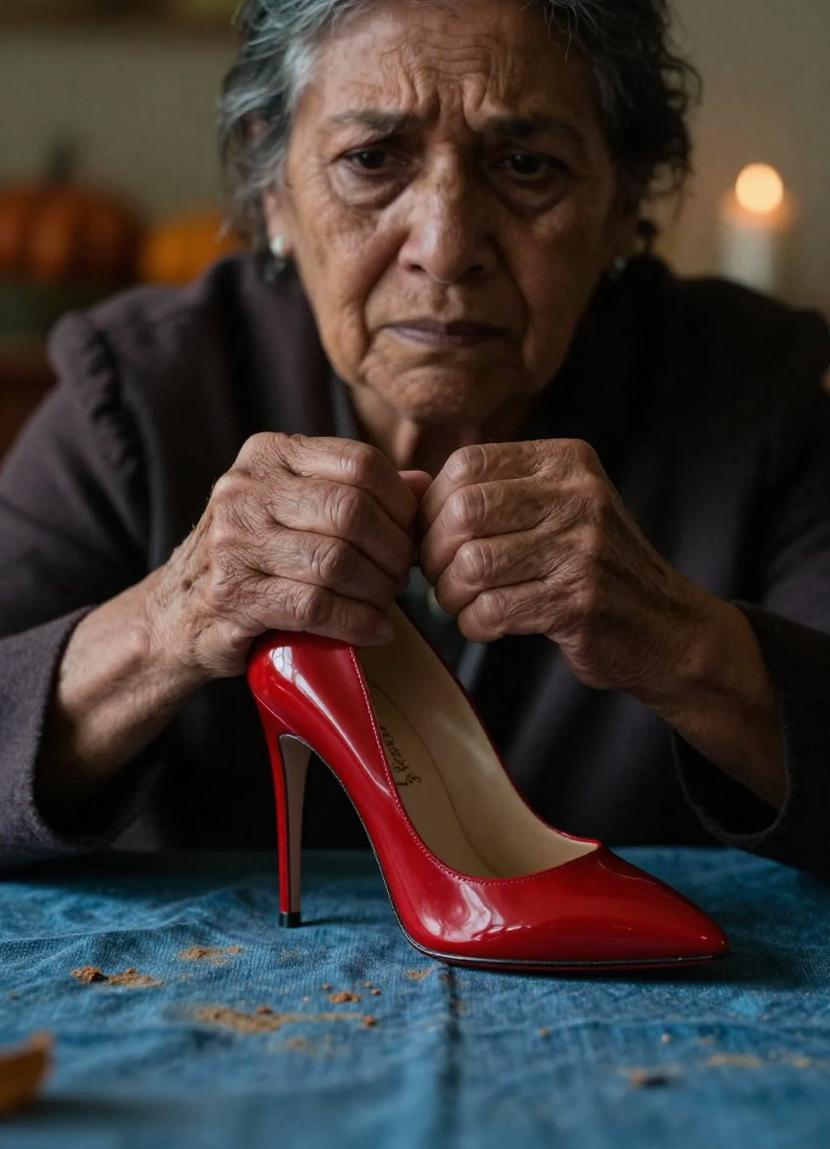
Without a flicker of remorse, she dropped it to the floor and raised her red Louboutin heel. Then, with cruel precision, she stomped down onto the fabric, grinding the heel into the blue cotton.
“You expect us to keep this garbage as a family heirloom?” she sneered. “Take your lies and your cheap crafts and get out.”
Beneath her heel pressed not just cloth, but the memory of my husband — and something inside me snapped. Not rage, not agony, but an awakening. A shift from silent endurance to fierce sovereignty. From invisibility to power.
I didn’t shed tears. I no longer had any to give. I fixed my gaze on my son, Dylan — the boy I raised through relentless storms and crushing poverty. He sat at the head of the table, eyes cast down like a man caught in shame, silent in my defense.
Slowly, I knelt, lifting the soiled runner. A crescent of dirt blemished the delicate fabric like a bruise. I brushed it away. My eyes stung, but not with sorrow.
Rising, I straightened the tissue paper wrapping the ruined gift and reached into my coat pocket.
There, folded and unassuming, lay a cream-colored envelope — a quiet promise I had crafted three years earlier.
Activate Clause 22.
That envelope was my last line of defense. And right now, it had to speak.
———
Part 1: The Thief and the Baker
To understand why I clutched that envelope, you must first know Maggie’s past before the diamonds and designer heels.
I first encountered her name on a scrappy resume when she was nineteen, applying for a cashier position at my humble bakery, Maggie’s Hearth. She arrived late, thick with nerves, fibbing about experience and clueless about sourdough varieties. But the smile she wore could melt stone. I hired her, driven by a belief in second chances — a mercy I craved once myself at that age.
Three weeks passed, and the till was short. One evening, staying late in the kitchen, flour-dusted hands trembling, I caught her — slipping two twenty-dollar bills into her apron.
I did not call the police. I sat her down with a cup of tea.
“I could ruin your record,” I said quietly. “But I won’t. Leave now. Never return.”
Three years later, Dylan came home with Maggie. “Mom, this is Maggie.”
She was changed—polished, educated, claiming a marketing degree. Dylan was entranced, gazing at her like she’d dropped from the stars. I kept my mouth shut. How could I tell my son the woman he loved was a thief? Would he believe me, or see a jealous mother? I swallowed my fears and stood silent as they married.
And Maggie took command. Slowly remodeling Dylan, his home, our lives. Probing finances with sharp questions. His software startup had crashed years before, debts mounting silently.
What none of them knew was that beneath my baker’s apron, I was a secret orchestrator. My late husband left debts, yes — but I had cleared them and invested quietly and shrewdly. I transformed a modest life policy into a towering fortune. I lived humbly in a two-bedroom cottage, but on paper, I was a financial giant.
When Dylan’s company floundered, I intervened, funneling money through shell investors into his failing firm to protect him. I saved his home.
But James, my lawyer, was cautious.
“Elena,” he warned, “You’re giving him power. And if he marries that woman, you need protection.”
So we drew the Emotional Equity Agreement. Dylan signed without eyeing the fine print, granting operational control and asset use—including the house, owned by The Elena Alvarez Trust—unless Clause 22 was invoked.
Clause 22: If the Beneficiary (Dylan) or spouse publicly humiliates, abuses, or estranges the Grantor (me), all assets, property, and voting rights revert immediately and irrevocably to the Grantor.
Maggie didn’t know Clause 22 existed. To her, the fortune was a jackpot: the house, the cars, the private schools. She believed she had won everything and that I was the worthless old mother-in-law to be tolerated.
———
Part 2: The Thanksgiving Unraveling
Thanksgiving was Maggie’s grand performance. Twenty guests — friends, neighbors, business hopefuls. A stage for her triumph.
The moment I arrived, the air was thick with artifice.
“Elena,” Maggie hissed, voice brittle, “You brought another one of your little projects? How charmingly quaint.”
She snatched the box from my hands and flung it onto the sideboard like trash.
The dinner was a gauntlet of subtle barbs. I was relegated to the farthest seat, beside a stranger’s toddler. Maggie toasted “success” and “building an empire from nothing,” staring at Dylan, ignoring the woman who quietly financed it all.
Then came the blow.
Maggie rose, raising a glass with a malicious smile.
“Surprise,” she declared, brandishing a DNA test.
The room fell into a suffocating hush.
“Dylan,” she said, “you love your mother, but she’s lied about your father. The story about a high school sweetheart who died? Fabrication. That man never existed.”
I froze. The truth spilled out. I had lied.
In 1983, a nineteen-year-old janitor, I was assaulted and became pregnant. I wove a story to shield my son from the brutal reality — to grant him a father he could honor, even if only imagined.
“She’s a fraud,” Maggie announced, eyes gleaming with venom. “Not a saint—just a woman hiding shame behind lies. You don’t belong here, Elena. You’re a mistake.”
Dylan’s gaze dropped. No defense, no rebellion.
“Mom,” he whispered, “maybe… a retirement home is better. Somewhere structured.”
Structured. Like I was an item to be managed or discarded.
I saw the death of my hope in my son’s eyes.
I rose sharply, the chair scraping brutally against the floor.
“I’m leaving,” I declared.
“Don’t forget your trash,” Maggie snarled, grabbing the box, dumping it onto the floor, and viciously stamping her heel on the blue fabric.
“Get out,” she hissed.
I reached into my pocket, withdrew the cream envelope, and placed it gently beside Dylan’s wine glass on the sideboard.
“Just a thank-you note,” I said softly. “For the hospitality.”
I walked out, never looking back.
———
Part 3: The Power Unleashed
Back in my quiet cottage, I brewed tea with steady hands. A text buzzed—Eli, my grandson, had recorded the ordeal.
“Grandma, I’m so sorry. Do you want the video?”
I replied: “Yes.”
Attached was the damning footage: Maggie’s venom, Dylan’s coldness, the heel crushing the shirt.
I opened my laptop, began an email to James.
Subject: ACTIVATE CLAUSE 22.
Attached were the timestamps and videos. Photos of Maggie’s threatening eviction texts weeks ago.
I clicked send.
At 8:06 AM the next morning, while Maggie luxuriated in silk pajamas in their ‘home,’ a courier rang their doorbell.
Maggie answered, annoyed, accepting a thick packet.
“Mrs. Turner? You and your husband have 15 days to vacate the premises.”
“What? This is my house!”
“It is not,” the server replied. “Ownership revoked under Clause 22 of The Elena Alvarez Trust. The residential grant is terminated.”
Dylan appeared, bewildered, handed another packet.
“Mr. Turner, effective immediately, your voting rights in Elara-Tech are suspended. All assets have reverted to Primary Trustee Elena Alvarez.”
“Reverted?” Dylan stammered. “But she’s just a baker!”
“She is the Grantor,” the server confirmed. “She owns it all, and you violated your allowance’s terms.”
By noon, bank accounts froze, company cards declined, Maggie’s Range Rover lease canceled.
The local gossip mill buzzed by evening. The real explosion came when the local paper, tipped by a “concerned citizen” (James), ran the headline:
“Local ‘Self-Made’ Tech CEO Unmasked as Trust Beneficiary; Loses Empire After Thanksgiving Tirade.”
The article included Eli’s viral video.
The internet erupted. Maggie became the villain of the week. #Clause22 trended. Her cruelty dissected, her shoes mocked. People saw that the “trash” she stomped was a labor of love.
Dylan called me five times. I let each ring go to voicemail.
Maggie’s long, desperate texts of apology and stress were met with a resolute block.
———
Part 4: Quiet Rebirth
I left my small cottage not out of necessity, but for a fresh start. I purchased a farmhouse on the town’s edge, with sprawling gardens and a bright studio for sewing.
I didn’t keep all twenty-two million. Comfort was enough. I established a trust for Eli, beyond his parents’ reach.
The rest funded the Elena Alvarez Foundation — supporting older women battered by financial abuse and family betrayal. The shelter is named The Indigo Shirt Haven.
Six months later, Dylan showed up at my gate — gaunt, broken, living in a cramped apartment. Maggie had abandoned him the moment the money vanished, now suing me unsuccessfully while dating a used car dealer.
“Mom,” Dylan said over the intercom, “I’m sorry. I was weak. She poisoned me.”
I looked at him through the camera — the son who had watched me eat alone.
“I forgive you, Dylan,” I said, “but forgiveness doesn’t mean access. You made your choice. Now you live your life on your own dime.”
I did not open the gate.
I returned to my garden—rows of lavender and hydrangeas—and my Tuesday sewing circle.
They thought they could bury me. But they forgot I was a seed.
Sometimes the best revenge isn’t shouting or fighting. It’s reclaiming what’s rightfully yours — then closing the door behind you.
I am Elena. I am no ghost.
I am the owner of this house.
And finally, there is peace.