
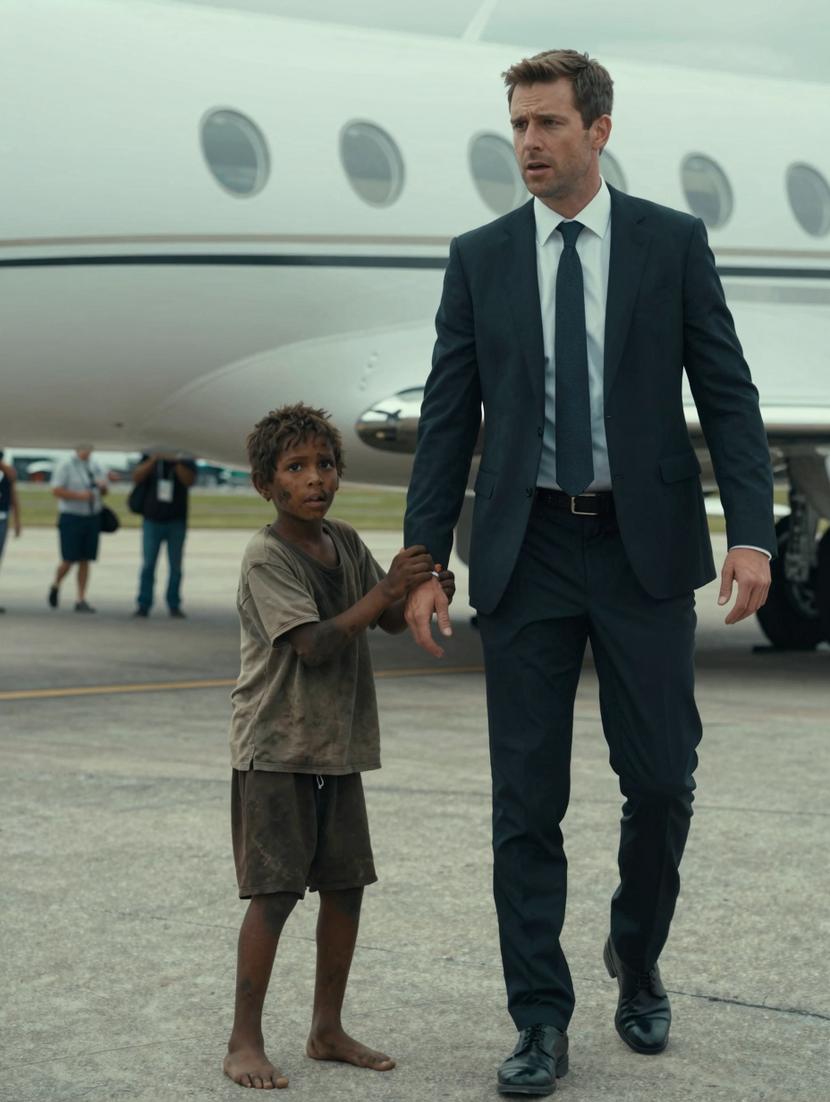
The roar of the jet engines filled the humid morning air as the boy sprinted across the tarmac. Witnesses would later say they barely saw him—how could they? A barefoot child on a runway meant for the elite, not a place for stray souls. His shirt hung loosely, frayed at the shoulder; smudges of black oil streaked across his dirt-smudged face like tribal markings forged in the heat of an unseen battle. He was no older than twelve, thin as a rail, trembling as if hunted by shadows nobody else could see.
At the center of this high-stakes world walked Julian Mercer—man of nine-figure fortune and absolute control. Julian adjusted the pristine cuff of his bespoke Italian suit while striding toward his private jet, phone wedged between shoulder and ear, his voice a cadence of cool authority.
“Tell them I’ll sign after we land,” he said, words clipped, unyielding. “No delays.”
Then—the sudden tug. A tiny, grimy hand yanked at Julian’s sleeve.
“Sir—please—don’t board that jet!” The boy’s voice cracked—part desperate scream, part earnest plea.
Julian froze mid-step.
The air hostess was quicker to react—a sharp click of heels on concrete as she stepped forward, face tight with disbelief and irritation.
“What do you think you’re doing?” she demanded, shoving the boy away. “You have no right to be here!”
The boy stumbled but didn’t collapse. His fingers grasped the wing’s edge; his eyes wild, breath ragged like a trapped animal. ‘Please,’ he implored, “please, sir—”
“Security!” the hostess barked. “Remove him!”
Heads turned. Pilots paused. Ground crew exchanged glances. Two suited men pretended not to see. This was Julian Mercer’s world: problems were swept under the carpet, silenced before they could speak.
Most men would have ignored the boy, turned and walked away.
But not Julian.
Something stopped him—the boy’s fierce silence, his lack of begging or tears, the unblinking stare fixed beneath the jet.
“Stop.” Julian’s voice cut through the chaos, sharp and commanding.
The hostess spun, shocked. ‘Sir, he’s causing a scene—’
“I said stop.” Julian’s gaze was steel. “Let the boy speak.”
An uneasy hush fell over the runway.
Noah swallowed hard, hands shaking as he forced the words out. “I clean under planes. Wipe oil. Check bolts. I’m not supposed to touch anything else, but I saw—”
The hostess scoffed, derision clear.
Julian didn’t look at her.
“What did you see?” he pressed.
The boy’s voice dropped to a haunted whisper. “A man messing underneath. Not maintenance. Not wearing the company colors. He hid something.”
A long pause hung in the heavy air, only broken by the sharp scent of jet fuel.
And for the first time in years, Julian Mercer felt a ghost he thought long buried—unease.
Six Hours Earlier
Noah. That was the boy’s name. No last name that anyone knew or cared to ask.
Each morning, before dawn’s first light, Noah appeared—sweeping hangars, wiping grime from aircraft bellies, earning just enough for a meal that was never quite certain. No papers, no safety net, only the steady hum of planes to keep him grounded.
Planes were honest. Loud. Dangerous. Clear as day what they were.
People? Not so much.
That morning, Noah’s sharp eyes caught something wrong immediately.
A man crouched beneath the sleek private jet—too polished for maintenance, too jumpy for ground crew. His glances over his shoulder were frantic; his movements hurried but careless.
Noah said nothing.
He watched.
The man slipped something small and tightly wrapped into a panel under the wing. Precise. Deliberate.
Then, as if rehearsed, he wiped his hands on his trousers and walked away like nothing happened.
Once the coast was clear, Noah crawled under the jet—not touching, just observing.
Enough was enough.
By the time he sprinted towards Julian Mercer, his lungs burned, legs trembling, but his resolve burned brighter than the pain.
Back on the Runway
Julian’s gaze locked on the jet’s underside.
Years of navigating razor-thin financial margins taught him to trust patterns, not people. And right now, the pattern screamed danger.
“Call maintenance,” Julian ordered softly.
The hostess laughed, nerves betraying her confidence. “Sir, there’s no time. We’ve clearance for takeoff.”
“No,” Julian said with finality. “We are grounded.”
Security arrived shortly—two men, pivoting between efficiency and cold professionalism.
“Sir,” one said, nodding toward Noah, “we’ll handle the boy.”
Julian shook his head.
“You’ll handle the plane, first.”
The hesitation was instantaneous but brief.
“Now,” Julian demanded.
Maintenance swarmed like a pack.
Minutes later, a piercing scream tore through the calm.
Hidden inside the panel: a device. Small. Sophisticated. Deadly.
Not a bomb meant for fireworks—no catastrophic explosion.
A silent death trap—engine failure triggered mid-flight, designed to send the jet crashing in silence.
Pandemonium erupted.
Authorities scrambled. Phones blared. The hostess gasped as color drained from her face.
Julian Mercer didn’t flinch.
Instead, he looked at the boy.
Noah, slumped against a wall, trembled now that the adrenaline faded.
“You saved my life,” Julian said with a quiet intensity.
Noah shook his head, eyes fierce despite his frailty. “I just didn’t want anyone to die.”
What No One Talks About
News stories screamed headlines—Julian the hero, the foiling of a terror plot.
But the silence about nearly ignoring Noah? Deafening.
How fast the broke wanted to erase the boy’s voice.
How easy it was to dismiss an invisible child.
Julian understood that world—it was built on noise and power, on drowning out the unheard.
But invisibility—true invisibility—could kill.
Two days later, Julian summoned Noah to his office.
The boy arrived in ill-fitting clothes, eyes darting, braced for dismissal.
Julian didn’t sit behind the desk.
He sat opposite him, meeting his gaze.
“What do you want?” Julian asked, voice unexpectedly gentle.
Noah blinked, confused.
“If you could have anything—anything at all,” Julian said, “what would it be?”
The boy thought—long and hard.
“A job,” he said at last. “A real one. With training.”
Julian smiled, a rare, genuine curl of lips.
“Consider it done.”
The Part No One Expected
Weeks passed, and the truth emerged.
The saboteur wasn’t a shadowy terrorist.
He was a corporate mercenary, hired by a rival company desperate to crush Julian’s deal by any means.
No ideology—only greed.
That reveal barely made a ripple.
It’s easier, the world decided, to believe in monsters than in plain, ruthless avarice.
Julian changed after that.
Quietly.
Privately.
He funded training programs for kids like Noah.
Insisted on background checks where none had existed.
And every time a voice was silenced because it didn’t “belong,” Julian remembered a small boy on the runway.
One Last Scene
Months later, inside a gleaming hangar, Noah stood tall—boots polished, uniform neat, confidence unwavering.
Julian, watching from a distance, saw him explaining technical details to a circle of engineers—calm, precise, commanding.
The same air hostess passed by, not recognizing the once lost boy.
Julian allowed himself a quiet smile.
Because the world almost missed its warning.
And because sometimes, the difference between life and death isn’t power—
It’s who you choose to listen to.
Final Line
He was rich enough to ignore the warning. Alive because he didn’t.