
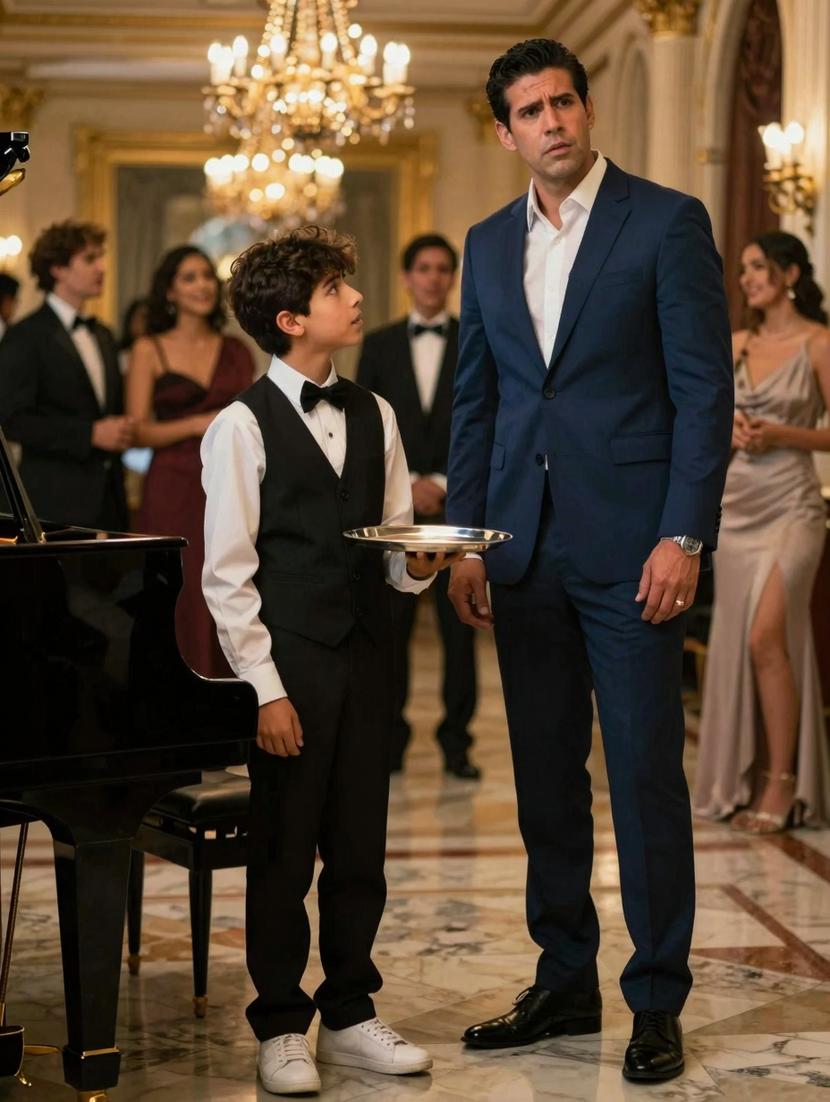
The chandeliers in the grand hall shimmered like ethereal constellations, their glowing crystals casting a cascade of warm, golden light across the gleaming marble floor. The air was alive with a symphony of laughter, the soft murmur of conversations weaving between clinks of crystal glasses. This was a night when opulence needed no introduction—it breathed in every corner, in every sumptuous drape, and in every effortless smile worn by the guests.
Against the far wall stood a grand piano, lacquered in midnight black, silent yet commanding, like an ancient sentinel awaiting a worthy hand.
Near its polished surface, almost swallowed by the glittering throng, stood a slender boy in a flawless waiter’s uniform. He couldn’t have been more than fifteen. His shoes, scuffed at the edges but meticulously clean, whispered stories of many quiet steps. His hands, steady yet undeniably young, carefully balanced a silver tray bursting with sparkling glasses.
No one seemed to notice how long Matías had been silently fixed on the piano, the instrument pulsing quietly in his thoughts.
To the crowd, he was merely background—a shadow who moved unobtrusively, spoke only when spoken to, disappearing into doorways when duty allowed. But deep within Matías’s chest, a fierce heartbeat throbbed louder than the party’s jubilations. Every soft note drifting from the distant string quartet was a whisper from a past that beckoned him closer.
He breathed in, gathering courage that had slowly built through the evening’s shadows.
With tentative steps as if afraid to break a fragile spell, Matías crept closer to the piano. Standing nearby, a tall man in a tailored navy suit laughed with an entourage. His wristwatch gleamed arrogantly—a fortune that could overshadow the boy’s entire family income.
The boy’s voice emerged, quiet and unsure but laced with raw sincerity.
‘May I… play the piano?’
Laughter rippled around the man, pausing sharply like a record scratched. The man turned, eyes narrowing as they traveled from the gleaming tray and pristine uniform down to Matías.
‘You?’ the man scoffed, voice dripping with disbelief loud enough for the room to catch. ‘Ever even touched a piano before?’
Light chuckles swooped through the audience—not cruel but dismissive, the kind of amusement born when a hope seems undeniably naive.
A flush rose to Matías’s cheeks, the old reflex to bow his head, retreat, and vanish urging him back.
But something fiercer rooted him to the spot.
He didn’t protest or explain. No defense needed. He merely gave a solemn nod, setting his silver tray with a delicate clink on a nearby table.
The fragile sound echoed louder than the music itself.
Without another word, Matías approached the piano bench and settled himself.
Across the grand hall, a murmur rippled—curiosity, skepticism, fading interest.
His hands rose, hovering just above the keys as if greeting a long-lost friend after years apart.
The room seemed to pause, breath held tight.
As his sleeve shifted back, a faded guitar-shaped tattoo appeared on his wrist—a quiet emblem, worn but unmistakable.
The man in the expensive suit’s smirk faltered, tension creeping into his gaze as his eyes fixed on the mark.
For the first time that evening, his smile vanished.
Matías pressed a key.
A single crystal-clear note soared—pure, deliberate, and haunting.
Then another, and another.
Within moments, what began as a tentative exploration swelled into a rich, vibrant melody that erased conversation like a wave eroding sand. The music was more than beautiful; it was raw and alive with yearning, memory, hope, and loss—the untold story of a boy’s soul expressed through every keystroke.
Guests stood still, glasses frozen mid-toast, servers pausing in their tracks as the sound filled every corner of the immense hall. This was not just a display of skill or youth; this was belonging.
Near the piano, the once-amused man clenched his jaw, a strange tangle of emotions knotting in his chest: disbelief, recognition, something almost long lost.
Years before, in secluded music circles, a video had made quiet rounds—of a child no older than eight playing with extraordinary brilliance on a battered roadside keyboard. The performance was raw, aching, unforgettable. Then the child had vanished from sight, leaving no trace, just a simple guitar symbol drawn beside the keys.
The man’s voice fell to a whisper, barely audible, trembling with incredulity.
‘Could it be… are you the one?’
Matías didn’t pause his playing. But deep in his eyes, an unspoken answer shimmered.
The last note lingered like an unanswered question suspended in the thick air.
Silence enveloped the hall—deep, complete.
Then, like a soft awakening, one hand began to clap.
Followed by another.
In seconds, the room exploded with thunderous applause, unanimous and overwhelming. People rose to their feet, some cheering, some simply stunned into reverence by the revelation they’d just witnessed.
Matías lowered his hands gently, as if afraid he’d revealed too much.
The man stepped forward, the veil of mockery fully lifted.
‘What’s your name?’ he asked softly, with newfound respect.
Matías hesitated, then breathed out,
‘Matías.’
To the crowd, the name held no weight. But the music was undeniable proof of something rare and extraordinary.
‘Where did you learn to play like that?’ the man pressed.
Matías glanced at the piano, then at his own hands.
‘My mother,’ he said quietly. ‘Before she got sick.’
The simple truth settled heavily.
‘I used to play in the subway after she couldn’t teach anymore,’ Matías continued, voice barely above a whisper. ‘Someone recorded it. Then we had to move. I stopped playing for a while.’
‘Why?’ the man asked, voice gentle.
Matías dropped his eyes.
‘Because playing didn’t pay for medicine.’
Those words landed like a stone, stark and unforgiving. Around them, the glittering luxury suddenly felt fragile, as though embarrassed to stand beside such raw reality.
The man swallowed hard, confronting a feeling he hadn’t known in years—regret.
‘I’m sorry,’ he said, voice thick with sincerity.
Matías shook his head slowly.
‘It’s okay. You didn’t know.’
In that moment, the man grasped an unshakable truth: talent could emerge from anywhere. Greatness required no wealth. And sometimes, the quietest presence in the room held the most extraordinary light.
‘Matías,’ the man said carefully, ‘would you… play again? Not as a waiter. As the musician you truly are.’
Matías looked up, uncertain.
‘For everyone?’ he asked.
‘For the world,’ the man affirmed.
Months later, that same haunting melody filled a vastly different hall. Larger, brighter, packed with people who came for one reason only.
A grand piano rested center stage.
And beside it sat a young performer no longer invisible, no longer unnoticed.
When Matías’s fingers touched the keys, the music carried the very soul of that magical night in the mansion.
But now, there was no laughter.
Only hushed, awed silence—and a crowd listening with hearts wide open.
Somewhere in the audience, the man who once mocked quietly wiped tears from his eyes—grateful he had been so wrong.
Because sometimes, the smallest question—
‘Can I play this piano?’
—is the first note of a life the world almost overlooked.
And sometimes… the one no one sees is the one everyone has been waiting for.