
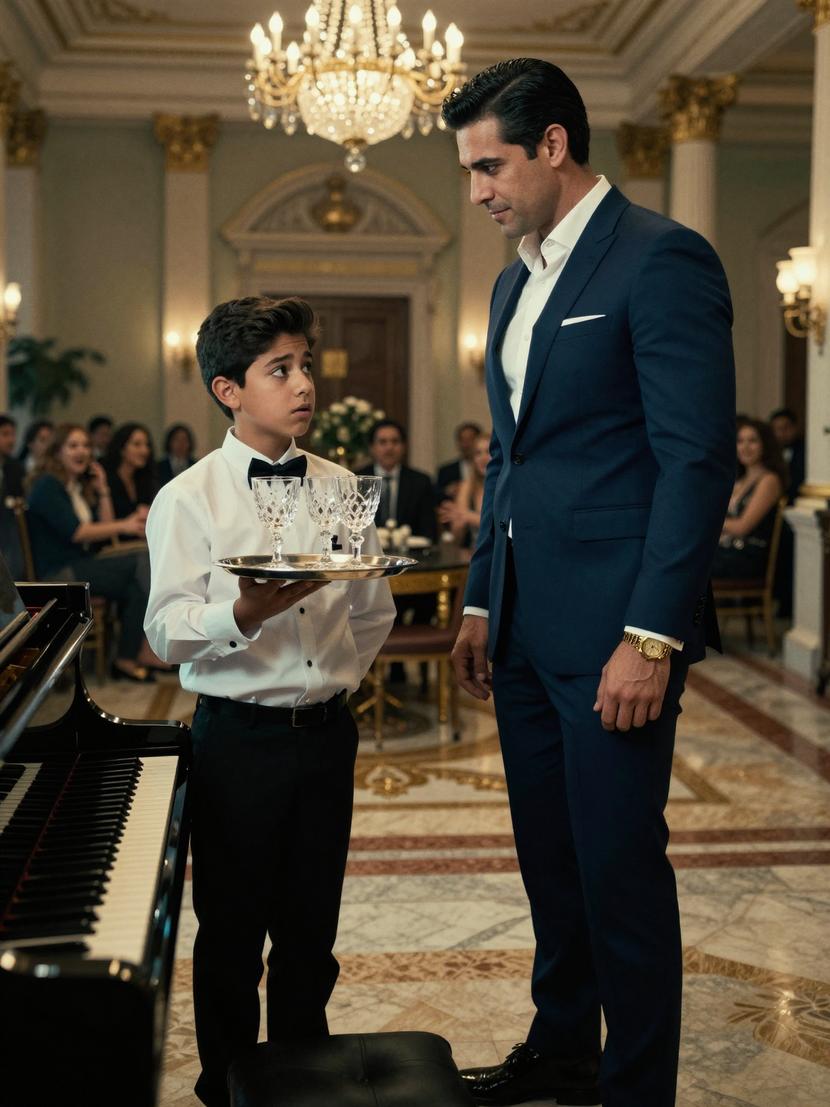
Underneath the grand chandelier, its crystals glittering like shards of frozen starlight, the vast hall pulsed with an air of effortless luxury. Golden light spilled over marble floors polished to an impossible shine, mingling with waves of laughter, murmured conversations, and the soft, distant clinking of fine crystal glasses. Wealth here was a silent host—no grand introduction necessary—woven into the very fabric of the evening, resting on silk gowns and expensive cologne, in every careless smile that flitted across the room.
Near the farthest wall stood an imposing black grand piano, sleek and glossy, silent yet commanding attention like a noble beast awaiting a worthy hand to rouse it from slumber. Beside it, nearly invisible amid the glittering guests, stood a slender boy in a pristinely pressed waiter’s uniform. He was no more than fifteen, his shoes polished but frayed at the edges, and his young, steady hands balanced a silver tray heavy with sparkling glasses.
No one seemed to notice how long Mateo had been staring at the piano, his gaze tethered by an unseen force. To the crowd, he was just background, a soft shadow among the gleam of wealth, moving with practiced quietness and disappearing whenever duty called elsewhere. Yet within Mateo’s chest, a fierce pulse outpaced the murmuring party—each delicate note of the background music was a fragile thread pulling him closer.
The courage he’d been gathering all evening swelled, and with a deep breath, he edged a tentative step toward the piano. Nearby, Mr. Calderon, a tall man in an impeccably tailored navy suit, was deep in laughter with a cluster of guests. The gold watch on his wrist gleamed—a costly flash dwarfed only by the wealth in his presence.
Mateo’s voice, soft and uncertain but charged with honesty, broke through the crowded hum. “May I… play this piano?”
Mr. Calderon’s laughter stuttered, the circle pausing briefly. His sharp eyes scanned downward, landing on the boy’s uniform, on the silver tray, on Mateo himself. A slow smirk crept across his face.
“You?” His voice was loud enough for others to catch. “Have you ever even touched a piano before?”
Some guests chuckled lightly—no cruelty, just that casual dismissal reserved for the obviously impossible. A blush flared on Mateo’s cheeks. The old reflex stirred: drop your gaze, apologize, retreat, vanish unseen.
But something stronger held him rooted.
He didn’t protest, didn’t make excuses, didn’t defend his worth. Instead, he nodded once, quietly, then set the silver tray down on a nearby table with a soft clink that seemed louder than the music itself.
Without another word, Mateo approached the piano bench and settled onto it. A ripple of quiet curiosity spread through the crowd—some amused, others skeptical, a few already distracted.
He lifted his hands slowly, reverently, as if greeting a dear old friend long absent. The hall seemed to hold its breath in that suspended moment.
As his sleeve shifted back, a small, faded guitar-shaped tattoo appeared on his wrist—simple, unadorned, yet unmistakable.
Mr. Calderon’s smile faltered and vanished. His eyes locked onto the tattoo, recognition sparking where amusement had been moments before.
Mateo pressed a single key—a clear, pure note that cut through the room. Then another. Then another, weaving together into a melody that grew richer and more alive by the second. The murmurs of the party faded without anyone noticing, swallowed by a music that spoke of something far deeper than beauty: longing, memory, hope, loss. Every unspoken feeling etched itself into the sound emerging from Mateo’s fingertips.
Guests turned, glasses paused midair, and even distant servers froze, caught in the swell of the music. It enveloped the immense hall as though it had always belonged there, each note striking with confident mastery far beyond the boy’s years. This was no mere display of talent—it was a homecoming.
Near the piano, Mr. Calderon felt a tight knot twist in his chest—an impossible recognition from years ago. A faded memory of a private video passed quietly through exclusive music circles: a child no older than eight, playing with raw, breathtaking brilliance on a battered roadside keyboard. The child had vanished without a trace—no name, no history—only a small guitar symbol drawn beside the keys.
His voice dropped to a hushed breath. “Wait… are you the one?”
Mateo never paused his playing, yet in his eyes, an answer flickered.
The last note lingered, fragile like a question no one dared to break.
Silence fell—heavy and complete. Then, softly at first, a single clap echoed. Another followed, then another, until the entire hall erupted in applause that seemed too immense for the quiet boy on the bench.
Some guests stood, some cheered, and some simply stared, struggling to process what they had just witnessed.
Mateo lowered his hands gently from the keys. For a moment, a flicker of fear returned to his eyes—like he had revealed more of himself than he intended.
Mr. Calderon stepped forward, his amusement gone entirely, replaced by something gentler.
“What’s your name?” he asked quietly.
Mateo hesitated, then whispered, “Mateo.”
To the crowd, it meant nothing. But the music still resonated through the room as undeniable proof of a rare gift.
“Where did you learn to play like that?” Mr. Calderon pressed.
Mateo glanced down at the piano, then at his hands. “My mom,” he said softly. “Before she got sick.”
The simple words deepened the silence around them.
“I used to play in the subway after… after she couldn’t teach me anymore. Someone recorded it. Then we had to move. I stopped playing for a while.”
“Why?” Mr. Calderon’s voice was low, filled with quiet concern.
Mateo’s eyes dropped. “Because playing didn’t pay for medicine.”
The truth hung heavier than any note ever could.
Around them, the opulence seemed suddenly fragile, almost ashamed.
Mr. Calderon swallowed hard, wrestling with a long-forgotten emotion: regret.
“I’m sorry,” he murmured.
Mateo shook his head gently. “It’s okay. You didn’t know.”
But in that moment, Mr. Calderon understood something profound. Talent could rise from anywhere. Greatness cared not for wealth or privilege. And sometimes, the person pouring drinks was the most extraordinary spirit in the room.
“Mateo,” he said carefully, “would you… play again? Not as a waiter. As a musician.”
Mateo looked up, uncertain.
“For everyone?” he asked.
“For the world,” Mr. Calderon replied.
Months later, the same melody filled a dazzling concert hall—larger, brighter, crowded with eager faces who had come for one reason only.
On stage sat a grand piano, polished to perfection.
Beside it, a young man—no longer invisible—prepared to share his soul.
When Mateo’s fingers touched the keys, the music carried the same aching beauty as that unforgettable night in the mansion. But this time, no one laughed.
They listened.
And somewhere in the crowd, Mr. Calderon wiped a quiet tear from his eye—grateful he had been wrong.
Because sometimes, the smallest question—
“Can I play this piano?”
—is the spark that ignites a life the world almost let slip away.
Sometimes, the one everyone overlooks is the very one they’ve been waiting for.