
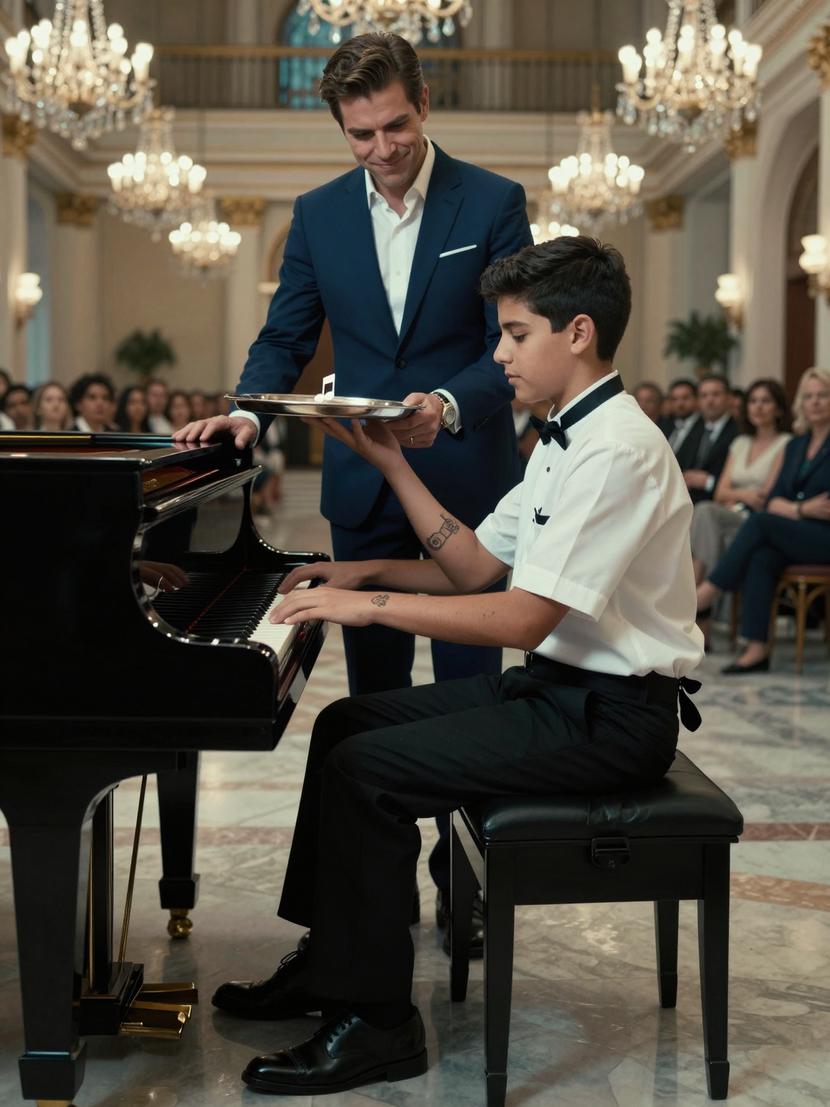
The grand hall breathed luxury; its chandelier lights shimmered like frozen constellations, scattering golden sparks that danced across the spotless marble floor. Laughter wove seamlessly into the soft murmur of conversations and the delicate chime of crystal glasses, creating an atmosphere where opulence wasn’t announced—it simply permeated every corner, every whisper, every careless smile.
At the room’s far edge, a glossy black grand piano stood silent yet sovereign, as if patiently waiting for the right soul to awaken its voice.
Standing nearby, almost swallowed by the glittering crowd, was a slender boy clad in a flawlessly pressed waiter’s uniform. He looked no older than fifteen. His shoes were polished but bore faint scuffs at the edges, and his hands—youthful yet steady—balanced a silver tray brimming with sparkling glasses.
No one seemed to notice how his eyes lingered on the piano, as if drawn by a silent magnet.
To the revelers, he was merely part of the service cadre: unobtrusive, soft-spoken, fading away when unseen. But inside Mateo’s chest, a wild rhythm thudded louder than the music’s hum. Each subtle note from the background tracks pulled at him like a ghost from his past, a memory calling him nearer.
He swallowed hard, summoning a courage painstakingly gathered over the evening.
Tentatively, almost reverently, he edged toward the piano. A tall man dressed in a sleek navy suit laughed heartily with his companions nearby. The man’s gleaming watch probably cost more than Mateo’s family earned in years.
Mateo’s voice cracked slightly as he asked, barely more than a whisper, “May I… play this piano?”
The laughter around the man stalled like a snapped thread. The man turned, eyes narrowing down to the uniform, the waiter’s tray, then settling on the boy.
A smirk pulled tight across the man’s lips. “You?” he scoffed, loud enough for the room to hear. “Have you ever even touched a piano before?”
A ripple of chuckles spread among the guests—not mocking, simply amused, like shaking a head at a fanciful child’s claim.
Heat rushed to Mateo’s cheeks. The familiar urge surged: lower your gaze, apologize, retreat, vanish.
But something stronger rooted him in place.
He said nothing, made no excuses. He only gave a single, steady nod and carefully set the silver tray down on a nearby table. That soft clink of silver against wood sliced through the room’s buzz like a call to attention.
Without waiting for permission, he sat at the piano bench.
A hush swept over the crowd—some curious, some dismissive, others skeptical.
Mateo lifted his hands slowly, fingers hovering like a long-lost friend reunited after too many years.
The room seemed to hold its breath.
As his sleeve slipped back, a small, faded guitar-shaped tattoo revealed itself on his wrist—simple but unmistakable.
The man’s amused expression flickered and then hardened, eyes locking onto the mark.
For the first time that evening, his lips lost their smile.
Mateo pressed a single key.
A pure, clear note blossomed and lingered.
Then another.
And one more.
Within moments, the tentative notes matured into a rich, living melody that wove through the hall, silencing every whispered conversation. It wasn’t just beautiful; the music carried depths of yearning, memory, hope, and quiet sorrow—the unspoken stories held within Mateo’s heart.
Guests turned slowly, glasses paused mid-air, and even distant servers halted, caught in the spell.
The melody claimed the vast space as if it had belonged there always, each note punctuated with a confidence far beyond the boy’s years. This was no mere performance or talent; this was where he belonged.
Near the piano, the man in the navy suit felt an unfamiliar tension grip his chest—a stir of recognition too sharp to ignore.
Years ago, a video had circulated quietly through exclusive music circles: a child no older than eight playing with astonishing brilliance on a battered roadside keyboard. The performance was raw, electric, unforgettable.
Then the child disappeared. No name, no trace—only a simple symbol drawn beside the keyboard: a small guitar.
The man’s voice dropped almost to a breath, barely audible. “Wait… are you the one?”
Mateo never paused his playing.
But in his eyes, an answer shimmered.
The final note hung in the charged silence like a question no one dared to disturb.
Then, a solitary clap—a tentative spark.
Another joined it.
In moments, applause erupted, swelling beyond the quiet boy at the keys. People stood, some cheering, others simply stunned, striving to grasp the wonder they’d witnessed.
Mateo gently lowered his hands from the keys, vulnerability flickering across his face, as though he’d unveiled too much of himself.
The man stepped forward, shedding all mockery.
“What’s your name?” he asked softly.
Mateo hesitated, then whispered, “Mateo.”
The name meant little to the crowd, but the music lingered, echoing proof of something rare and true.
“Where did you learn to play like that?” the man pressed.
Mateo’s gaze shifted between the piano and his own hands.
“My mom,” he said quietly. “Before she got sick.”
The words hung heavy.
“I used to play in the subway after… after she couldn’t teach me anymore,” Mateo continued. “Someone recorded it. Then we had to move. I stopped playing for a while.”
“Why?” the man asked gently.
Mateo’s eyes dropped. “Because playing didn’t pay for medicine.”
The truth settled like a weight heavier than any note.
Around them, the grandeur suddenly seemed fragile—awkward in the face of raw reality.
The man swallowed hard, wrestling with a grief and regret long buried.
“I’m sorry,” he said.
Mateo shook his head, a quiet grace in his refusal. “It’s okay. You didn’t know.”
In that moment, the man realized something profound: brilliance could spring from any soil, greatness cared nothing for wealth, and sometimes, the unnoticed waiter carried the most extraordinary soul in the room.
“Mateo,” he said carefully, “will you… play again? Not as a waiter. As the musician you are.”
Mateo looked up, uncertain.
“For everyone?”
“For the world,” the man affirmed.
Months later, that haunting melody filled a different hall—far larger, bathed in bright light, packed with an audience summoned for a single reason.
On stage stood a grand piano.
And beside it, Mateo—the once invisible boy—now radiant and seen.
As his fingers touched the keys, the music carried the same breathtaking soul as that night in the mansion.
But this time, no one laughed.
They listened.
And among the crowd, the man who once mocked him wiped tears from his eyes—grateful he had been wrong.
Because sometimes, the smallest question—“Can I play this piano?”—becomes the first step toward a destiny the world nearly missed.