
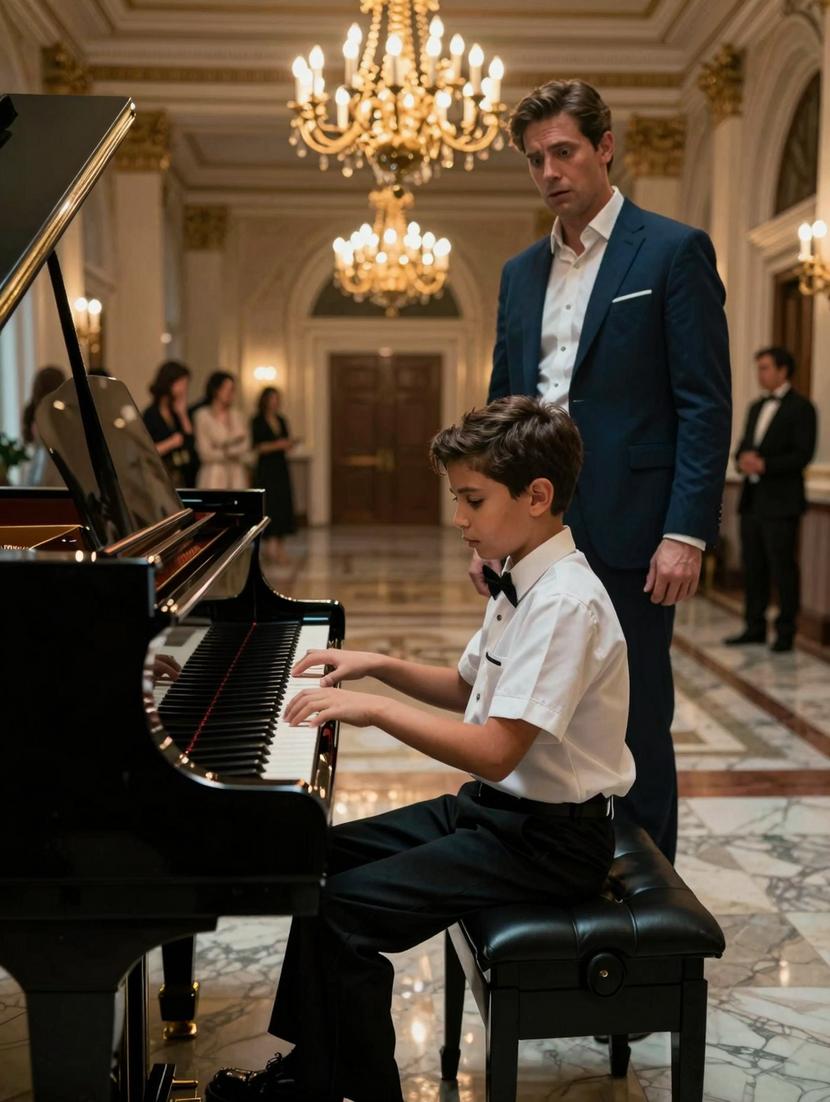
In the grand hall, the chandelier gleamed like a constellation trapped in crystal, casting a warm golden glow that danced softly on the marble floor below. Laughter wove through the air, mingling with the murmur of refined conversation and the delicate clinking of champagne flutes, painting a picture of effortless luxury.
This was an evening where opulence needed no introduction—it breathed from the rich fabrics, whispered from the carefree smiles, and rested in every polished corner.
Against the far wall stood a sleek black grand piano, silent yet majestic, as if poised patiently for the right soul to unleash its voice.
Leaning quietly beside it, almost invisible to the sparkling crowd, was a slender boy in a crisply ironed waiter’s uniform. Not more than fifteen, his polished shoes showed frayed edges telling tales of long shifts, and his youthful yet steady hands balanced a silver tray studded with glittering glasses.
No one noticed how long Adrian’s eyes lingered on the piano.
To the revelers, he was just another server—moving unseen, speaking softly, vanishing when his presence wasn’t required. Yet, inside him, a storm raged louder than the music. Each faint note weaving through the background stirred memories, beckoning him closer.
He swallowed hard, summoning a courage that had been silently building throughout the evening.
Careful not to shatter the moment, he took a tentative step toward the piano. Nearby, the man stood in an impeccable navy suit, laughing with a cluster of guests. His shining watch likely cost more than the boy’s family made in a lifetime.
Adrian’s voice emerged soft and tentative, but honest and true. ‘May I… play this piano?’
The laughter around the man paused—a breath caught in elegant denial. The man’s gaze scanned downward before locking onto the uniform, the tray, the boy standing there.
A smirk curled his lips.
‘You?’ he sneered, loud enough to draw attention. ‘Have you ever even touched a piano before?’
A few polite chuckles rippled through the guests, not harsh but dismissive—the kind reserved for dreams deemed impossible.
Heat flooded Adrian’s cheeks. For a heartbeat, the old instinct fought to pull him back: look down, apologize, fade away.
But something fiercer anchored him.
He said nothing defensive. No explanations, no protests.
He simply nodded once, deliberate and steady, then gently set the tray down on a nearby table.
The soft clink of silver on wood sounded louder than any music in the room.
Without another word, Adrian moved to the piano bench and sat.
A hush rippled across the crowd: some curious, others amused, several already indifferent.
He lifted his hands slowly, fingers trembling slightly as though greeting a distant friend after years apart.
The hall seemed to exhale, waiting.
As his sleeve slid back, a faded tattoo shaped like a small guitar appeared on his wrist—simple yet impossible to ignore.
The man’s amused smile faltered; his eyes fixated on the mark.
For the first time that night, he was silent.
Adrian pressed the first key.
A single note soared—pure, crystal-clear, intentional.
Another.
Then another.
In moments, the tentative sounds blossomed into a rich, vibrant melody that hushed every whispered conversation across the hall. This was no mere performance—it was a tapestry woven from deep longing, frail memories, hope, and poignant loss. Every ounce of the boy’s unsaid stories pulsed beneath his fingertips.
Guests turned, glasses paused mid-air, even servers at the far end stilled as if time bowed to the music.
The melody spilled into every corner of the cavernous hall, claiming the space as its own. Each note landed with the certainty of one who had long called this place home.
By the piano, the man felt an unfamiliar tightness—something raw, unyielding: recognition.
Years ago, a video had silently circulated among elite music circles—a child no older than eight, playing with breathtaking, unpolished brilliance on a battered roadside keyboard. The performance was raw emotion incarnate, unforgettable, and then… silence. The child disappeared, with no name, just a small guitar symbol scrawled next to the keyboard.
The man’s voice fell to a whisper, barely breathing the question, ‘Wait… are you the one?’
Adrian’s fingers never faltered.
But in his eyes, an answer quietly shone.
The last note lingered, a fragile question suspended in the air.
Then silence—profound and complete.
Slowly, a single hand clapped.
Then another.
Within heartbeats, the entire hall erupted in applause, overwhelming the small boy at the keyboard. People rose, some cheering, others stunned, trying to process the miracle they had witnessed.
Adrian folded his hands away from the keys with care.
For a moment, his eyes held a flicker of fear—as if the music had bared too much of his soul.
The man approached, his derision replaced by a solemn respect.
‘What’s your name?’ he asked, voice low.
Adrian hesitated, then whispered, ‘Adrian.’
No one in the room connected the name to anything yet, but the music remained—a testament to something extraordinary.
‘Where did you learn to play like that?’ the man pressed softly.
Adrian’s gaze drifted between the piano and his own hands.
‘My mother,’ he said quietly. ‘Before she got sick.’
Those simple words deepened the silence around them.
‘I used to play in the subway after… after she couldn’t teach anymore,’ Adrian continued. ‘Someone recorded it. Then we had to move. I stopped for a while.’
‘Why?’ the man asked gently.
Adrian’s eyes dropped. ‘Because playing didn’t pay for medicine.’
The truth dropped heavier than any note.
Around them, the glittering world of privilege suddenly felt fragile, almost ashamed.
The man swallowed hard, confronting a feeling long buried: regret.
‘I’m sorry,’ he confessed.
Adrian shook his head softly.
‘It’s okay. You didn’t know.’
But in that moment, something crystallized for the man.
Genius could arise from anywhere.
True greatness was blind to wealth.
And sometimes… the boy serving drinks was the very soul the world had missed.
‘Adrian,’ the man said carefully, ‘would you… play again? Not as a waiter. As a musician.’
Adrian looked up, uncertain.
‘For everyone?’ he asked.
‘For the world,’ the man answered.
Months later, the same melody echoed through a grander hall—brighter, filled with people who had come for one reason.
On stage stood a grand piano.
Beside it, a young artist no longer invisible.
When Adrian’s fingers touched the keys, the music carried the same heartbeat as that unforgettable night.
But now, no one laughed.
They listened.
And somewhere within the crowd, the man who once mocked him quietly wiped tears from his eyes—grateful that he had been wrong.
Because sometimes, the smallest question—
‘Can I play this piano?’—
becomes the opening chapter of a life that nearly went unheard.
And sometimes… the one unseen is the one everyone’s been waiting for.