
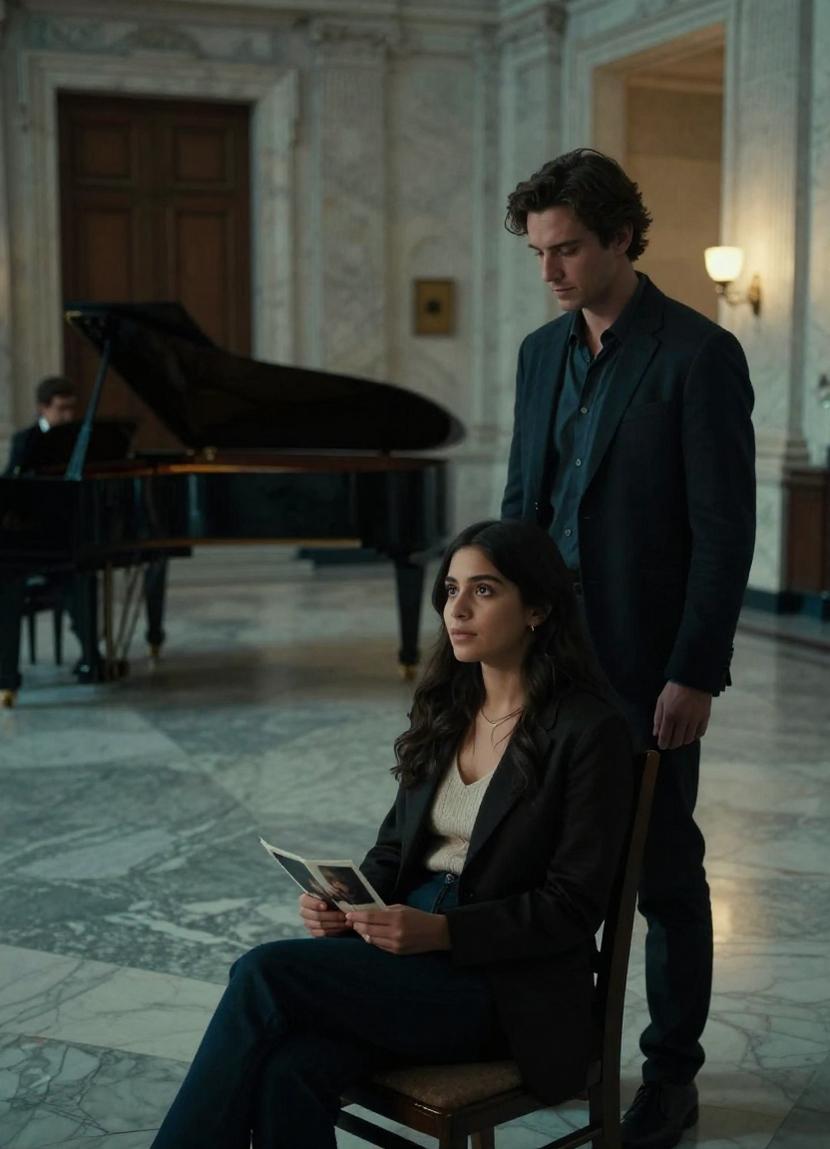
Marisela slowly lifted her gaze, her eyes reflecting a serene composure far beyond her years—calm in a way that spoke volumes about the battles she’d silently fought. ‘I’m listening,’ she murmured, voice barely above a whisper.
Matias knitted his brow. ‘Listening to what?’
She inclined her head subtly toward the massive doors of the Grand Solario’s main hall. ‘The piano,’ she said softly. ‘It’s like the music is sad… but fighting to be hopeful.’
Matias turned, finally noticing the pianist seated near a gleaming grand piano. The haunting melody wove through the half-empty main hall, rich notes reverberating off the cold marble. Until now, Matias’ mind had been trained only to register numbers, contracts, and flashing screens—never melodies lingering in the air.
‘Why does that matter so much to you?’ he asked gently.
Marisela hesitated, fingers tightening around a folded photograph she withdrew from her worn cloth bag—but she kept it close, concealing it.
‘My mother played the piano,’ she whispered. ‘Before she fell ill. When she played, it was like the world stopped hurting—just for a little while.’
Something softened in Matias’ eyes.
He cleared his throat, a trace of awkwardness in his voice. ‘You shouldn’t be sitting here alone. Where are your parents?’
Her gaze dropped to the floor. ‘My father left long ago. My mother passed away last winter. I stayed with neighbors for a while… but then there was nowhere else to go.’
Outside, rain dripped steadily from the Grand Solario’s awning, mingling with the city’s ceaseless hum of life and loneliness. Matias glanced at his watch—the meeting upstairs awaited, important guests pressing for his attention. Yet his feet remained rooted.
‘You must be hungry,’ he said quietly, not really asking.
Marisela nodded once. ‘I am. But I’m used to waiting.’
That simple sentence struck him harder than any accusation.
Matias exhaled, the weight of an unfamiliar resolve settling in. ‘Come inside,’ he said softly. ‘Just until you’re warm.’
She hesitated, eyes darting toward the polished glass doors. ‘I won’t cause any trouble.’
‘I know,’ Matias reassured her.
The warmth enveloped Marisela the moment she stepped into the Grand Solario. The pianist caught sight of them and eased the melody into something softer, gentler. Matias ordered a modest meal—soup, crusty bread, steaming hot chocolate.
Marisela ate with slow, careful movements, as though savoring the fleeting magic of safety and kindness.
‘What do you dream of becoming?’ Matias asked, leaning forward.
For the first time, her lips curved into a small, genuine smile. ‘I want to play music,’ she said simply. ‘Not to be famous, or adored. Just… to help people breathe a little easier when life feels too heavy.’
Matias looked away, touched deeply. Years ago, music had been his own refuge—a sanctuary drowned out by ambition’s relentless roar.
That night, beneath the sharp glare of city lights, Matias made calls he had long avoided. Lawyers. Social workers. Foundations. This time, the mission was driven not by tax breaks or public image, but by the fragile hope cradled in front of him.
Marisela did not return to the streets.
She was enrolled in school, given piano lessons, and tucked into a small sunlit room that glowed with warmth and possibility. At first, words were scarce—the walls she’d built as protection were high. But music became her voice when silence spoke too loudly.
Months moved quietly by.
One cool evening, Matias stood silently at the back of the intimate Sonata Room. Marisela sat at the grand piano, her feet barely touching the pedals. Her fingers trembled—then found steady strength.
She began to play.
The melody carried the weight of gentle sorrow—sadness, yes, but fiercely resisting despair.
Matias felt an unfamiliar tightness rise in his chest.
For the very first time in years, his mind was no longer captive to thoughts of success, influence, or power.
It focused solely on a miracle that had almost slipped past unnoticed.
When the last note faded into the still air, the room held its breath—then erupted into heartfelt applause.
Marisela’s eyes found Matias in the crowd.
She smiled.
And in that moment, Matias understood a truth no fortune could ever teach:
Sometimes, the smallest voices carry the strongest hope.