
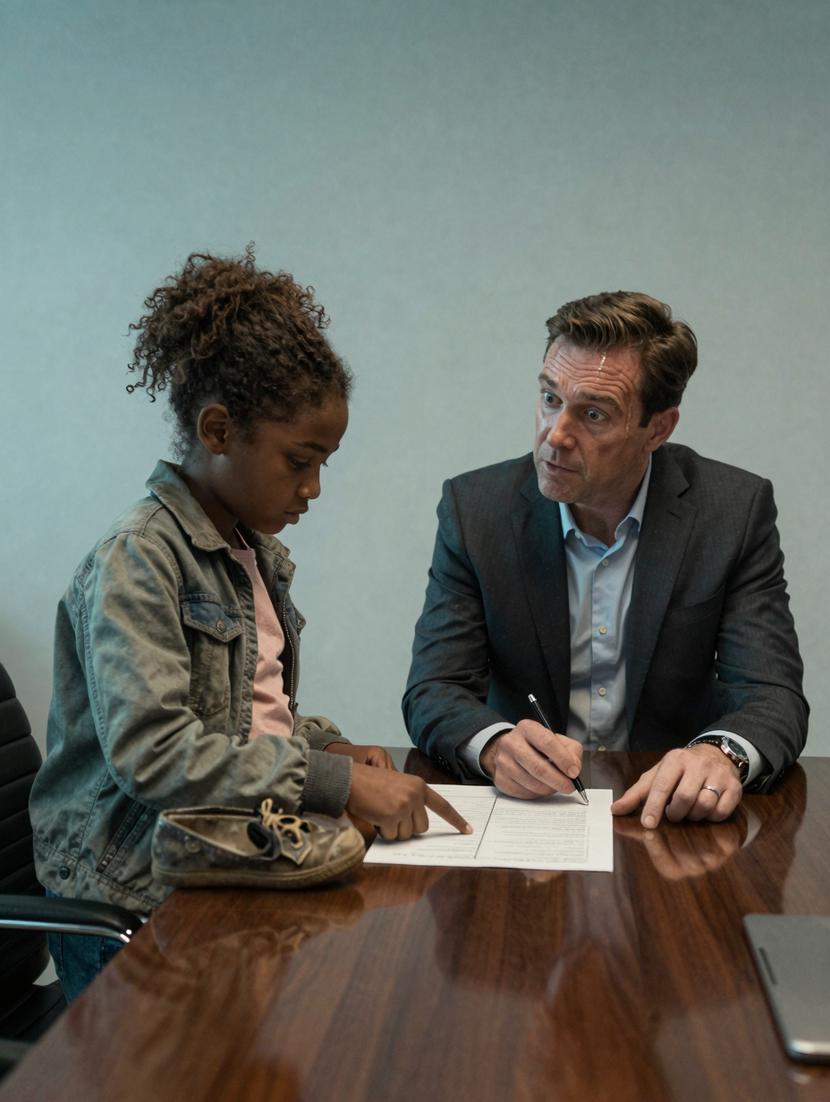
The sleek pen trembled just above the paper, casting a shaky shadow on the sterile conference room table. Dorian Vance’s hand quivered with a visceral fear, his fingers barely steady enough to make the final stroke that would seal his fate. The signature line waited, indifferent, but Dorian’s body screamed caution — because this moment wasn’t just ink on a page. It was the final breath of everything he had fought to build.
His suit, razor-sharp and flawless, contrasted starkly with the storm raging beneath his skin. A thin river of sweat traced down his temple, betraying the cold weight pressing on his chest. He swallowed hard but the lump stuck, choking the air.
Around the gleaming conference table, the room pulsed with silence. Lawyers sat like statues, their eyes locked on the bankruptcy agreement before them — a document as heavy as a coffin lid.
Then, unexpectedly: a voice, barely audible yet piercing the quiet.
“Sir… please don’t sign that.”
Heads snapped to the glass wall where a lone figure stood — a homeless girl no older than twelve, her threadbare jacket and worn shoes stark against the polished luxury around her. Security had allowed her inside only because outside, a vicious storm raged, and because she had quietly been helping guests hold doors in the lobby.
But now, her gaze was fixed not on people, but on the papers.
“There’s a mistake,” she said, voice steady despite her evident nerves. “A big one.”
The lead attorney’s chair scraped back sharply as he rose. “This is a private meeting. You need to leave.”
Dorian raised a hand, halting him.
“Wait.”
For the first time in weeks, Dorian’s voice carried a spark of hope rather than defeat. He studied her carefully, intrigue and desperation mingling in his eyes.
“What kind of mistake?”
The girl stepped cautiously forward, hesitating, then pointed to a precise line on the document.
“That clause transfers the entire debt from the Harborgate Port acquisition,” she explained. “But only sixty percent was supposed to move in the first five years. The rest hasn’t matured yet.”
A thick silence slammed down.
Dorian’s gaze dropped to Clause 17C — he’d pored over it countless times. So had every lawyer in the room.
And yet, now his heartbeat surged.
“Stop,” Dorian said, almost in a whisper. “Review that clause again. Immediately.”
The attorneys exchanged sharp, skeptical looks but obeyed.
Minutes crawled by, heavy with tension.
Finally, one lawyer swallowed audibly. “…She’s right.”
The atmosphere shifted, electric and full of disbelief.
“That portion of the debt… it shouldn’t legally be counted yet,” the lead attorney admitted. “Our liabilities have been grossly overstated.”
Dorian exhaled deeply, his lungs rediscovering air they’d forgotten.
“Find her,” he ordered with sudden authority. “Bring her back.”
Her name was Mira Okoye.
Since she was fourteen, Mira had faced the cruel edges of life alone. After her mother’s passing, the crushing weight of rent and loss had pushed her out onto the streets. She found refuge in subway stations, church shelters, collecting cans, and glimpses of kindness from strangers.
But numbers, they had always been a language she understood.
Her mother had been an accountant once, whispering, “Numbers don’t lie. People do.”
Though her schooling had been cut short, Mira’s sharp mind caught patterns others overlooked. On that fateful day, she hadn’t planned on scanning the bankruptcy papers. But the errant clause screamed to her — a glaring discrepancy that refused to be ignored.
Three days later, Mira sat in the heart of Vance Meridian Logistics, no longer near the exit, but side by side with Dorian Vance himself.
“Speak freely,” Dorian urged her quietly. “No hesitation.”
She laid it all bare: misclassified liabilities, losses inflated beyond reality, debts accelerated on paper to force the collapse of a company still viable.
A dark pattern emerged.
This wasn’t careless management.
It was deliberate manipulation.
Adrian Cole, the company’s CFO, abruptly left before the meeting concluded.
Within two weeks, independent auditors confirmed Mira’s insights:
Funds siphoned through phantom vendors, losses disguised as operating costs, numbers twisted just enough to slip under the radar.
Adrian Cole was swiftly removed pending a thorough investigation.
Six months later, Vance Meridian Logistics not only survived, it evolved.
Transparency became the company’s backbone, and rigorous oversight the norm.
Mira returned to school on a full scholarship quietly funded by a foundation Dorian never publicized.
Later, she came back — this time as a junior financial consultant.
On her first day, Dorian leaned in and said softly, “This company wasn’t saved by money. It was saved by someone brave enough to speak the truth when silence was so much safer.”
Mira smiled, small yet unshakable.
The real shift wasn’t in avoiding bankruptcy.
It was in realizing that:
Genius doesn’t demand a title.
Truth doesn’t ask for permission.
And sometimes, the quietest voice holds the most powerful key.
Because the most vital lines in life are often drawn by those we least expect to hear.