
Part 1: The Disguise
Most people believe wealth is an impenetrable armor. That once you cross into the billionaire echelon—the ‘three comma club’—your pain dulls, your worries vanish, and 3 AM anxieties dissolve into the night. But I’m Lucas Mercer, and I’ve learned the bitter truth: money doesn’t stop the bleeding or the late-night doubts. It only sharpens the edges.
From a muggy Seattle garage, I built Meridian Systems into a vast tech giant that powers much of the digital world. Private jets, sprawling estates across continents, a security detail tight enough to rival governmental protection—yes, I have them all. But not a single luxury can replace the sound of my wife Claire’s laugh or the warmth of her smile.
Since Claire died six years ago delivering our daughter Mia, my life has become a constant tightrope act. By day, the ruthless CEO concocting deals and defying industry giants. By night, a scared single father learning the art of braiding hair without pulling tears, and ensuring the ‘Tooth Fairy’ leaves the perfect sprinkle of glitter behind.
Mia is my anchor. She inherited Claire’s soulful brown eyes, tender and vast, filled with kindness that frightens me because the world isn’t always kind in return. That’s why Riverview Academy became our choice—not the priciest or flashiest school, but a place touted for character, integrity, and community. I wanted Mia to grow up with humility, a grounded spirit, away from entitled trust fund heirs who measure worth in yachts or designer shoes.
So I kept my identity buried beneath layers. On enrollment forms, I was a modest “Software Consultant.” School drop-offs happened quietly in a weary 2015 Volvo, not a flashy Aston Martin. I wanted Mia to be Mia, not an heiress wearing a gilded halo, craving genuine friends instead of sycophants.
That Tuesday morning, I’d been wrestling a merger with a firm in Singapore since 3 AM. The papers finally signed by 11, my lawyers burst into celebration with champagne and triumphant high-fives over a nine-figure payday. But all I craved was to shed my suffocating suit and find my daughter.
In the dim office bathroom, I slipped into my college-grayscale hoodie—its cuff threadbare from years—and old track pants. The mirror reflected dark circles under tired eyes and a scanty stubble, an image far from the polished titan I was. ‘‘Taking the afternoon off,’’ I told Natalie, my loyal assistant. When she asked with sly smirk if I was escaping to Harbor Pines, I shook my head, the ache blooming in my chest. ‘‘I’m going to have lunch with Mia.’’
The Volvo hummed softly as I pulled into Riverview Academy’s visitor parking. Sunshine draped the campus in gold—today felt like a day for second chances. Clutching a brown paper bag filled with red velvet cupcakes from Mia’s favorite bakery, I stepped inside.
‘‘Signing in for lunch visit,’’ I chimed. The receptionist barely glanced up, her eyes glued to a buzzing screen. ‘‘Name?’’ she snapped gum, disinterest dripping from her tone.
‘‘Lucas Mercer. Here to see Mia Mercer. First grade.’’
A puckered smirk crossed her lips as she eyed my faded hoodie and sweatpants. ‘‘Badge’s on the counter. Don’t overstay—these kids get wild.’’ Her patronizing pity pressed against me like a slap.
Suppressing a retort that I could buy and bulldoze this entire place in the time it took her to finish her text, I clipped the badge to my chest and walked the halls. Crayon-colored paintings adorned the walls alongside signs preaching kindness, respect, and community. I believed we’d made the right choice, that Mia’s future was bright here—until I rounded the corner to the cafeteria.
Part 2: The Cafeteria Incident
The cafeteria sprawled before me like a sunlit hall of childhood camaraderie. Rows of blue-uniformed kids chattered excitedly over pizzas and steamed vegetables, laughter and clatter mixing into a warm symphony. But my heart stuttered when I caught sight of Mia.
She sat shrunken at a corner table, arms wrapped around herself, shoulders trembling with silent sobs. Nearby loomed Ms. Harlow, the head lunch supervisor whose smile at Parent Night had sweetly wrapped her in warmth, now replaced by a venomous scowl twisting her face.
Drawing near, I saw the spilled milk glistening on the laminate table, droplets dotting Mia’s tray area.
‘‘I told you to hold it with both hands!’’ Ms. Harlow snapped, her voice jagged as broken glass.
‘‘It slipped,’’ Mia’s whisper cracked, fear threading every syllable.
‘‘Because you’re clumsy and messy!’’ Ms. Harlow growled, pushing Mia’s arm roughly aside as she scrubbed the spill with reckless aggression. Mia flinched, her tiny body shrinking further as my gut tightened to a painful knot.
‘‘Please, I’m hungry,’’ Mia begged softly, reaching for her sandwich.
A cruel laugh seeped from Ms. Harlow. ‘‘Hungry? You can barely eat properly, and you expect to be fed? Your parents must teach you nothing at home.’’
Grabbing the lunch tray—turkey sandwich, apple, cookie—she marched toward the trash bin.
‘‘No!’’ Mia’s voice cracked as she half-stood. ‘‘My daddy made that for me!’’
‘‘Well, your daddy’s not here to clean up your mess,’’ Ms. Harlow spat and with a chilling glare, tilted the tray. Thud. A splatter. The sandwich plunged into the rubbish, the apple rolling into forgotten mashed potatoes.
The cafeteria erupted into uneasy silence, the joyful buzz extinguished in an instant. Children paused, wide-eyed in fearful shock, as Mia broke down, curling into herself.
Ms. Harlow bent close, voice low but venomous enough for the room to hear. ‘‘You don’t deserve to eat. Sit there and think about how much of a burden you are till the bell rings. And if you touch anyone else’s food, you’ll be seeing the Principal.’’
My blood froze, then ignited. The crushed cupcakes in my hand turned to pulp; I stepped forward, shattering my disguise.
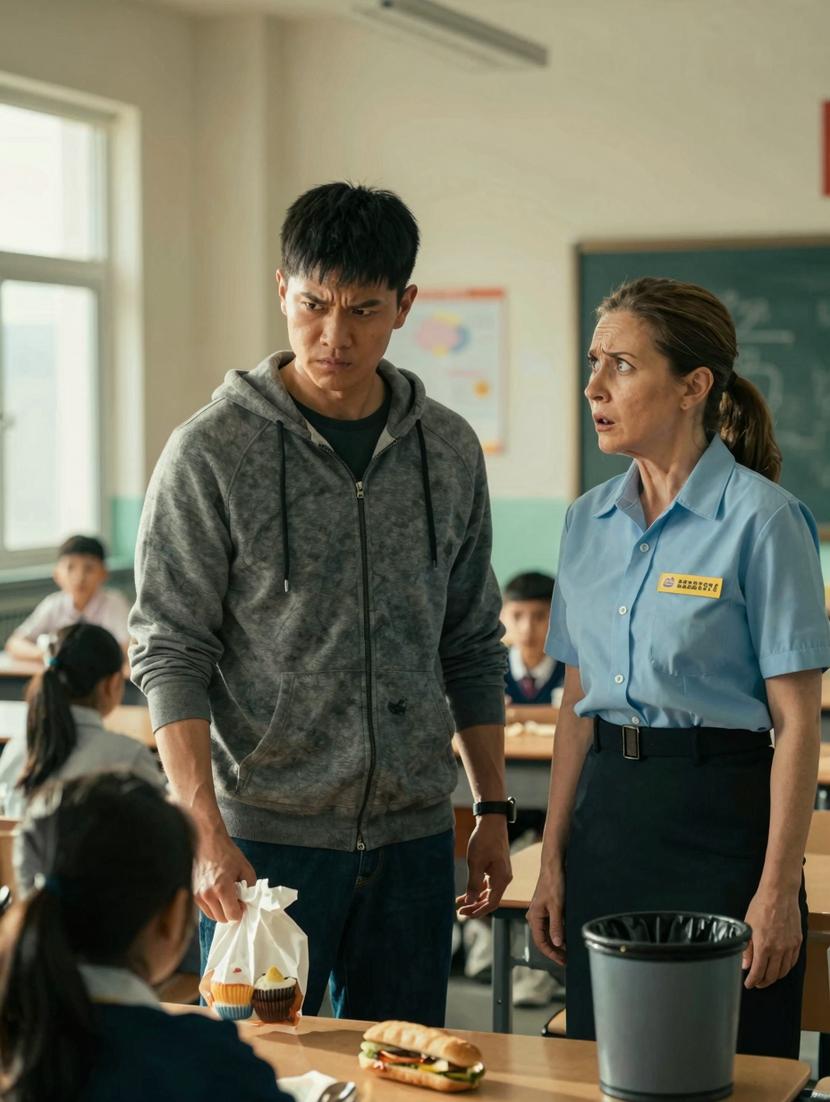
Ms. Harlow wiped her hands and spun towards me. Her eyes narrowed at the threadbare hoodie and unshaved face; I was invisible as Lucas Mercer, billionaire benefactor—just some scruffy intruder.
‘‘Who are you?’’ she snapped, dismissing me with a flick. ‘‘Parents aren’t allowed here unannounced. Leave now before I call security.’’
I approached steadily, the predator now revealed. ‘‘You threw her lunch away,’’ I said, voice low and deadly calm.
‘‘I was disciplining a student,’’ she said haughtily. ‘‘Is this your janitor? Because that milk spill needs mopping.’’
‘‘I’m not the janitor,’’ I replied coldly. ‘‘I’m Mia’s father—the girl you say doesn’t deserve to eat.’’
She sneered, scanning my clothes. ‘‘Lucas Mercer? I expected someone who could at least pay tuition. No wonder she’s so uncouth—apples don’t fall far from the tree.’’
She had no idea.
Part 3: The Reveal
‘‘Leave now,’’ Ms. Harlow’s voice lowered into a dangerous growl. ‘‘Or shall I have security drag you off? It’d likely traumatize your daughter, although her behavior surely fits rough living.’’
My teeth clenched so hard I feared a crack. But fury could wait—I needed ice, precision. ‘‘You think my daughter is used to rough living?’’ I echoed softly.
‘‘Look at you,’’ she sneered, gesturing at my hoodie. ‘‘If you’re struggling, we have financial aid programs. You should’ve applied instead of sending her here to beg.’’
‘‘Beg?’’ I glanced at Mia, trembling but fierce. ‘‘Daddy, it’s okay, I’m not hungry—let’s just go,’’ she whispered, trying to shield me from the storm.
That shattered me utterly.
I knelt beside her, ignoring Ms. Harlow. Gently, I brushed away a tear tracing a path through milk splashes. ‘‘You are hungry, Mia. And you’re going to eat. And never again will you be treated like this.’’
‘‘Don’t ignore me!’’ Ms. Harlow yelled, snatching a walkie-talkie from her belt. ‘‘Mr. Martin? Code Yellow in the cafeteria. An aggressive parent refusing to leave. Need backup.’’ She smirked at me. ‘‘The Principal is busy. He doesn’t tolerate trespassers.’’
‘‘Perfect,’’ I said calmly. ‘‘I want to see Mr. Martin.’’
The doors slammed open. Mr. Martin, a balding man clutching a suit stretched a little too tightly, strode in with Darren, the security guard. Martin’s annoyed gaze fell on me, a hoodie-clad figure glaring steadily down at Ms. Harlow.
‘‘What’s happening here?’’ Martin demanded, scanning the tense room.
Ms. Harlow spun a tale, her voice quivering into victim mode. ‘‘He barged in unauthorized, threatened me, making a scene over discipline.’’
Martin’s face hardened. ‘‘Sir, you must come to the office. We have zero tolerance for—’’ He froze, locking eyes with me.
‘‘Hello, Martin,’’ I said icily.
His complexion paled as if struck blind. Mouth opening and closing like a stranded fish, he glimpsed my badge: Lucas Mercer.
‘‘Mr. Mercer?’’ he stammered, voice cracking.
Ms. Harlow looked puzzled, switching gaze rapidly between us.
‘‘Martin, do you know this man?’’ I pressed.
Sweat glistened on his brow as he adjusted his tie nervously. ‘‘I… I didn’t expect you today. I would’ve met you at the door. Is this some new look?’’
‘‘It’s my day off. I came to lunch with my daughter. But apparently, she’s not allowed to eat, because your staff says she doesn’t ‘deserve’ to.’’
Martin’s eyes darted towards the trash bin, the ruined tray, then Mia’s tear-streaked face. The weight of realization settled—but Ms. Harlow remained blind to the truth.
‘‘Martin,’’ I said, locking eyes with the principal, ‘‘how much did the Mercer Foundation donate last year for the science wing?’’
He swallowed hard, voice shaky. ‘‘Three million dollars, sir.’’
Ms. Harlow gasped, a sick mix of shock and fear flooding her features. Her gaze traveled to a luxury watch gleaming ominously on my wrist—far pricier than her home.
‘‘Three million,’’ I repeated. ‘‘And next week, I planned to sign off on five million more for the new gym.’’
Color drained from Ms. Harlow’s face. Her trembling hand covered her mouth. ‘‘Mr. Mercer… I had no idea. You were dressed like a… regular person.’’
‘‘Exactly. Because I dressed like a normal person, you thought you could treat me and my daughter like garbage. But what infuriates me is this: you told a six-year-old she didn’t deserve to eat.’’
Part 4: The Corruption and The Cleanup
‘‘I didn’t mean it that way!’’ Ms. Harlow stammered, desperation seeping from every pore. ‘‘It was just a figure of speech!’’
‘‘You threw her lunch in the garbage,’’ I said sharply, pointing at the bin. ‘‘Is starving a child an educational method now?’’
‘‘It was an accident!’’ she lied, her facade crumbling.
Turning to the children seated nearby, I gently addressed a boy across from Mia. ‘‘Did the tray slip, or did she throw it?’’
He glanced nervously at Ms. Harlow before whispering, ‘‘She threw it. Said Mia was a burden.’’
A nearby girl chimed in, ‘‘She says we’re slow and yells if we eat too slow. Threw my lunch away last week. Calls us names.’’
The floodgates opened as the kids chimed together, voices overlapping in a chorus of misery and fear.
‘‘Remove her,’’ I commanded Martin. ‘‘Immediately.’’
Martin nodded, panicked. ‘‘Darren, escort Ms. Harlow to the office.’’
She resisted, screaming about tenure rights, until forced away.
I scooped Mia into my arms, burying my face in her hair. ‘‘Pizza, everyone. Ice cream too. On me.’’ Cheers erupted, laughter returning with fresh life.
But my battle was just beginning.
That night, while Mia slept beside me in the car, I mobilized my team. Private investigators. Legal experts. By dawn, I had unearthed the dark secret.
Megan, a mother and whistleblower, met me in a fading park twilight. She handed over a list. ‘‘It’s a pattern,’’ she whispered. ‘‘Ms. Harlow targets every child on financial aid. Each time one leaves, a wealthy family’s kid takes their spot. Mr. Martin gets bonuses. It’s a pay-to-play nightmare.’’
No lawsuits. No public relations war. I took control—purchasing the school’s debts, gaining ownership.
The next day, in a press conference clad in my signature suit, I unveiled the scandal. Financial records flickered behind me, evidence laid bare.
‘‘Ms. Harlow isn’t a victim but a predator,’’ I declared. ‘‘And Mr. Martin her accomplice. Today, I am the owner of Riverview Academy. They are both terminated.’’
Authorities awaited outside.
Two months later, I carried Mia back into a transformed cafeteria—bright, warm, welcoming. A new teacher’s smile greeted us.
‘‘Go on,’’ I encouraged Mia.
She grinned, that genuine spark shining through. ‘‘Eat.’’
Money can’t fix everything. But when it comes to taking out the trash? It can certainly help.