
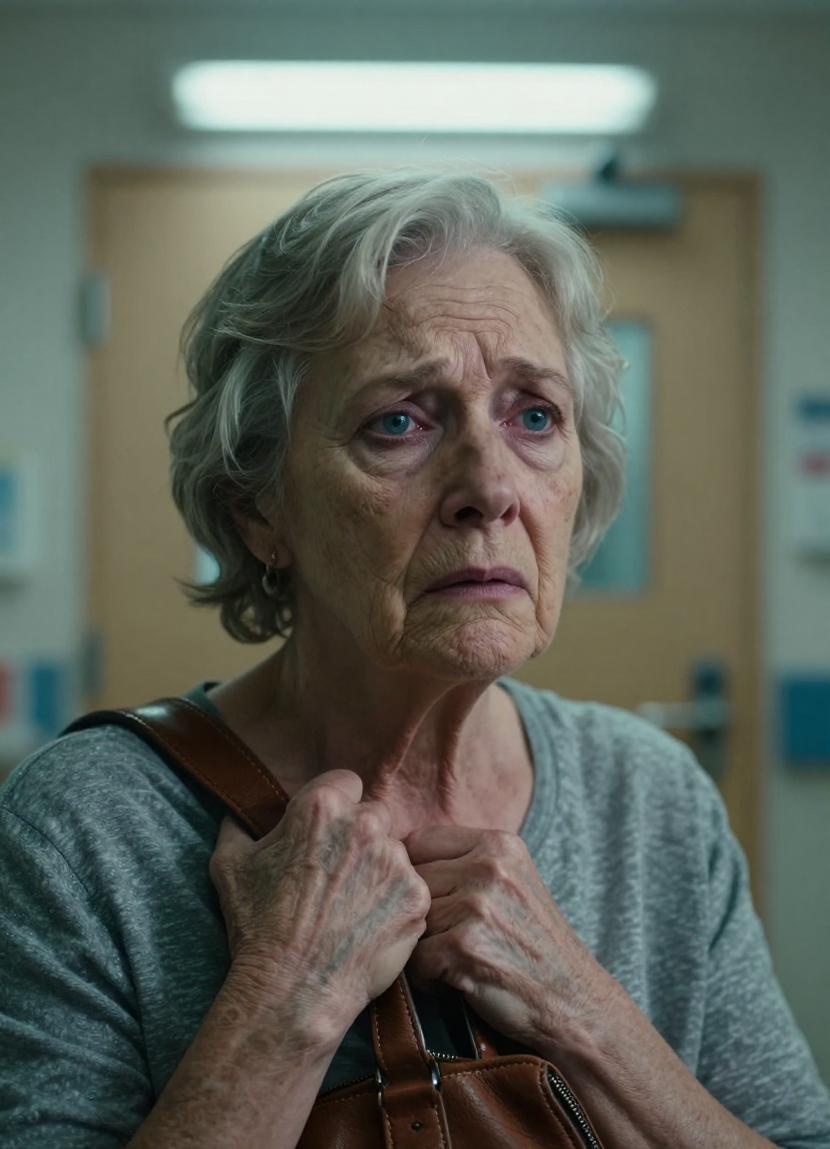
They say the loudest sound in the world isn’t a bomb or a scream. It’s the sharp click of a door shutting when you find yourself stranded on the wrong side. For me, that door was dull industrial beige—cold, unyielding—nestled on the windy fourth floor corridor of Saint Helena Hospital in New York City. The antiseptic mingled with the scent of freshly waxed floors, a blend that usually spoke of hope and healing. Tonight? It reeked only of rejection.
I had just endured a twelve-hour journey on a creaky Silverline bus. My swollen ankles throbbed painfully inside worn leather shoes. The navy blue dress I’d chosen carefully for today, heavy and wrinkled from the long ride, clung uncomfortably. The entire trip, I stared through fogged windows, watching Tennessee’s rolling hills dissolve into the gray steel skyline of the city—and dreamed of holding my grandson in my arms.
But here I stood, beneath flickering fluorescent bulbs, realizing I’d traveled across states only to be treated like a shadow.
David Harper—my son, the boy whose scraped knees I once kissed, whose dreams I worked tirelessly to support—stood mere feet away. Yet he refused to meet my eyes. His gaze bounced nervously across the sterile nurses’ station and the scuffed linoleum floor, anywhere but at me—the woman who gave him life.
“Mom,” he murmured, voice thick and hesitant, drenched in a shame that should have been mine but wasn’t. “Please don’t push it. Vanessa only wants her immediate family here.”
The words hung in the sterile air like a lie too bitter to swallow. Immediate family.
I searched for the child who once clung to me during thunderstorms. The tearful teen who had sought my arms after his father died. But that boy was gone, replaced by a man in a crisp shirt, treating me as a problem to be solved.
“I understand,” I whispered, my voice softer than I thought possible—steady and unbroken.
“She’s exhausted, Mom,” David added quietly. “She’s never really been comfortable with you. You know that.”
I nodded, swallowing the urge to shout or beg. My mother had once told me: when the world strips away your dignity, silence is the last armor you have.
Steeling myself, I gripped the strap on my battered brown leather purse—an heirloom from my own mother—and slowly turned away. I walked the long, sterile corridor past rooms brimming with celebration, past new grandmothers cradling newborns with joyful tears, and slipped out into the biting February wind without a glance back.
At the Sunset Inn, with walls so thin I could hear my neighbors’ late-night TV, I sat on a sagging mattress, phone dark and unwelcoming. The silence between my son and me wasn’t just a pause—it was the opening salvo of a war that would test everything I had left.
My name is Anna Harper. Born and raised in Nashville, I grew up on apple pie and the gospel of grit. I married Richard when I was twenty-two—a quiet man, owner of a humble hardware store. Our world was simple, warm, until the day Richard collapsed from a heart attack when David was just fifteen.
Richard left the way a candle blows out in a draft—quiet and sudden—leaving me alone with a grieving boy, a failing shop, and mountains of debt.
I didn’t drape myself in mourning veils or demand sympathy. I mourned in the hard way—with a mop in my hand. I sold the store, paid creditors, worked nights cleaning dental clinics where bleach became the scent of survival. Afternoons found me behind a receptionist’s desk. The soft hands that once kneaded dough grew calloused and cracked.
Yet, I smiled. Because of David.
He was my sun—brilliant, kind, endlessly determined. We studied under the flicker of kitchen lights and danced, crowing when he was accepted into the University of Chicago’s engineering program.
“I’ll build bridges, Mom,” he dreamed aloud, eyes sparkling. “The biggest one will be named after you.”
“Name it after Richard,” I said, smoothing his hair gently.
“Then it’ll be the Richard and Anna Bridge,” he promised.
I believed him. We were forged by loss, a family strong enough to weather anything. When he moved to New York for a prestigious job, I emptied my savings to cover his deposit, packed his bags, and let him go—that’s what mothers do. We are the launchpads, not the ceilings.
Change crept in like a slow tide eroding the shore—daily calls turned weekly, then monthly texts.
Enter Vanessa Collins.
An architect, polished and poised, daughter of New York’s elite. When David spoke of her, his Tennessee drawl began to fade, replaced by a sharper, distant cadence.
“She’s… different, Mom,” he said, trying on sophistication like a new coat. “Her family is very established.”
I tried. I sent cards, asked to meet her, but was met with carefully crafted excuses—busy schedules, visiting relatives, relentless work.
I was excluded from wedding plans, left out of dress fittings. When the invitation arrived, it felt like a summons, not a celebration.
I sat in the third row—behind pillars and shadows—while Vanessa’s mother raised a toast, calling David “the son she never had.”
I sipped my water, swallowing the grief that I had become the mother he wished didn’t exist.
But a baby changes everything, doesn’t it? When David told me Vanessa was expecting a boy, tears streamed freely. I poured love stitch by stitch into a soft yellow blanket, knitting dreams into every thread.
I shipped it with a note: Can’t wait to meet you, little Michael.
Three weeks pass. A curt text back: Thanks for the package. No photo. No reply.
Then came the birth—announced not by a call, but a Facebook post while I scrubbed floors at the clinic. Tiny Michael, perfect in his fragile newness. A comment from Vanessa’s mother gleamed cruelly: So glad I was there in the delivery room.
That struck like a knife—there they were, welcoming my grandson. And I? A photo on a screen.
I called David, desperate to visit. He stalled for two agonizing weeks before offering a single day.
And so, we’re back to that hospital corridor. That cold “immediate family” line. The twelve-hour bus ride home where I held a photo of five-year-old David, realizing that boy was lost to me.
I arrived before dawn in Nashville. The house echoed with cold silence. Brewing coffee, I braced for the humiliation to end.
It didn’t.
Two days later, the phone rang—an unknown New York number. I answered, expecting David, but instead met a clipped, professional voice.
“Mrs. Anna Harper?” the woman from Saint Helena Hospital’s billing department asked.
“Yes?”
“We’re contacting you to clarify payment for Vanessa Collins’s delivery and postpartum care.”
My heart clenched.
“Insurance covered standard care,” she clicked through her keyboard, “but the private luxury suite, specialized lactation consultant, and extended stay were not. An outstanding balance of $10,000 remains.”
Ten thousand dollars.
“Why call me?” My voice trembled.
“Your son, Mr. David Harper, listed you as guarantor and emergency contact.”
The world tilted.
He hadn’t called me through engagements or labor. He’d pushed me to the shadows when my grandson was born. Yet when the bill arrived? Suddenly, I was family again.
I closed my eyes, memories flaring—the bleach-stained scrubs, the nights surviving on noodles so David could study, the yellow blanket never touched, the rejection and loneliness.
Something inside snapped—not loud, but a quiet severing of the last tether.
“Mrs. Harper, we need a credit card today to avoid collections.”
Taking a deep breath, breathing in the familiar scent of coffee and worn wood from my kitchen, I spoke with icy resolve.
“There must be a mistake. I have no son named David Harper in New York. I cannot assist with this bill.”
“Ma’am, this info was provided directly by—”
“The information is incorrect. Good day.”
I hung up, hands trembling so hard I had to sit on them to still the shaking.
I waited.
Silence—but it shattered three days later in a torrent of frantic calls and texts:
Mom, pick up.
Mom, the hospital called.
Mom, this is embarrassing.
Mom, how could you?
The voicemail was the crescendo—David’s voice cracked with panic and anger:
“Mom, I don’t know what game you’re playing. The hospital threatens legal action. Our credit is ruined. Vanessa is crying, calling you vindictive. After everything, how can you do this? You’ve always been selfish with money. Call me now.”
Selfish.
Absurdity and cruelty wrapped in one word.
I sat before my computer, not to rant but to reveal my truth.
“David,
Your father taught us family helps family. But he also said family demands respect.
I traveled twelve hours to meet my grandson and was given five minutes. You said I wasn’t immediate family, that my presence was a burden.
I’m not a burden, nor an ATM. You cannot erase me when it suits you, then call me when you need.
I will not pay the bill. Find a solution.
If you want a mother, not a bank, I am here. Until then, goodbye.”
Two hours later, a curt reply: “Vanessa was right about you. Don’t contact us again.”
Tears streamed quietly. I had reclaimed my dignity but lost my son.
Silence became absolute.
Weeks passed. Months. I lived alongside their ghost.
Then, out of nowhere, the phone rang again—New York calls, but not Saint Helena billing.
It was Francesca Reyes, a social worker.
“Mrs. Harper,” she spoke gently, “this concerns your grandson Michael.”
My heart pounded. “Is he okay? Hurt?”
“Physically well,” she assured, “but Vanessa was admitted for emergency psychiatric evaluation after a severe postpartum psychosis episode compounded by stress.”
“David?” I whispered.
“Struggling. Lost his job, evicted, currently staying with Vanessa’s parents amid tensions. He’s at the hospital now but can’t care for Michael alone. You are listed as secondary contact.”
Secondary. Always the backup plan.
“What do you need?”
“Temporary custody of Michael for days or weeks. Otherwise, emergency foster care.”
Foster care—my grandson I held only briefly.
My wounded heart wanted to refuse. To say “call Vanessa’s mother.”
But the photo on my fridge reminded me who I was. That little boy, David—the lost soul.
“I’ll come,” I vowed. “I’m taking the next bus.”
This journey was different—no hope sought, no permission begged. A mission to reclaim family.
At dawn, I found David in the hospital lobby—eyes hollowed, shirt stained, a man crushed by loss.
“Mom,” he gasped, collapsing into my arms. Sweat and fear clung to him like a shroud.
I held him, no words—only comfort.
“I’m sorry. I’m so sorry. You were right. Everything’s gone,” he sobbed.
“Where is he?”
“Child services has him nearby. I couldn’t do this alone.”
We walked together to the nursery. Michael sat clutching a plastic truck, eyes wide but unfamiliar. Yet those eyes carried David’s spark.
“Hi, baby,” I whispered, gathering him into my arms. Solid. Real.
Turning to David, I declared: “We’re not staying in a hotel or with Vanessa’s parents.”
“We have nowhere,” he confessed.
“We’ll find a place,” I promised. “I have savings—the money not spent on your luxury suite.”
His brow tightened but he nodded.
We rented a humble apartment in Parkwood. For two weeks, I became mother again—cooking, cleaning, changing diapers, showing David how to soothe his son. I watched pride melt into humility.
When Vanessa was discharged, frailer yet human, fear gripped me. Would she lash out? Stand guard?
Instead, she fell to her knees, tears breaking through the icy facade.
“I’m sorry,” she whispered. “I was terrified of failing, of being imperfect. I broke.”
Handing Michael to David, I sat beside her—not forgiving, but understanding.
“Perfection is a lie,” I said softly. “A weight too heavy for anyone.”
Her eyes welled with vulnerability.
“My mother told me needing help was weakness. I pushed you away to hide my failure.”
The puzzle fit. Her fear. The exclusion. The “immediate family” barrier. It was not snobbery but desperation.
“I’m not your mother,” I told her gently. “Just a grandmother who loves her grandson.”
The healing road was long—marked by tough talks, apologies, and slow rebuilding.
I stayed a month, helping with deposits and rent. David found a less prestigious job, earning less but returning home. Vanessa kept therapy.
One night, over coffee, I confronted David.
“You hurt me. Made me feel invisible.”
“I know,” he admitted. “I got lost trying to fit in and forgot who I am.”
“You’re Richard Harper’s son,” I reminded him. “Remember where you come from.”
“I will,” he vowed.
When I left, it was by choice—not exile.
“Stay longer?” Vanessa asked, stronger now, cradling Michael confidently.
“I have my own life,” I smiled. “But I’ll be back for Christmas.”
“We’ll repay you,” David promised at the bus station.
“Just raise him kind,” I said, kissing Michael’s soft cheek. “That’s all the payment I need.”
Four years have passed.
Michael is five—calling me Nana Anna. When I visit, he runs into my arms with abandon.
David and Vanessa remain together, imperfect but real. Their marriage withstood storms built on truth, not illusion.
Vanessa and I are no fairytale mother-daughter pair. But mutual respect bridges our past pains. She sends photos, asks advice, treats me with dignity.
I’m sixty-five, still working part-time for routine and purpose. Mornings bring quiet coffee in my kitchen.
The silence now is peace—not loneliness.
On my fridge hangs a new photo—me, David, Vanessa, and Michael at the park. We laugh. My eyes are shut; Michael’s gaze shifted. Imperfect but authentic.
That night in the hospital corridor taught me a devastating truth: love doesn’t mean accepting scraps.
You teach people how to treat you.
By walking away, saying no, refusing to be an ATM—I didn’t lose my family. I saved it.
Sometimes, you have to let the bridge collapse to build a stronger one from its ashes.
To anyone standing at the wrong side of that door: stop knocking.
Turn and walk away.
Build your own home.
Because those who truly love you will find you. And if they don’t?
You have yourself—and after everything, that’s enough.